In case you are not already sick of me talking IN EVERY COMMENT SECTION ACROSS THE LAND about my favorite baby name book, I’m reviewing it today over at SundryBuzz.
Elizabeth’s vocabulary is developing rapidly. This weekend she pointed at me and said “YEAVE ME ‘YONE!” (Leave me alone.) Then she pointed to the enormous laundry pile and said, “YOU DO YAWN-HEE!” (You do laundry.) NICE. How ’bout a little “I yuv you”?
First weigh-in today! I’m down three (and a half) pounds. I love the first week of a diet, when my system is all “WHUH??” It’s harder to get excited later on when it’s a half-pound loss, or no loss at all, or even a little bump up.
Isn’t it weird how some diets stick and some don’t? I’ve been on so many half-day diets, where my resolve fails before I even get to lunchtime. It’s too early to celebrate this one’s success, but even getting past the 3-day point is a big deal to me.
Everyone has their own weak spot, and mine is SWEETS. I almost feel I can’t be happy in life unless I can be constantly grazing out of a sack of chocolates. Here are a few of the, um, sensible choice treats and desserts that have been pulling me back from the edge of the cliff:
1) Sugar-free fat-free Jell-o pudding, particularly the Chocolate Fudge flavor (the regular Chocolate tastes flat to me). I eat it with Lite Cool Whip, which makes it sweeter and more dessert-ish. It’s even better if you crumble up some graham crackers on it: tastes like one of those graham-cracker-crusted pudding pies.
2) Chai tea made with milk. Fill a coffee mug half-full of skim milk, then the rest of the way with water. Microwave for 2 minutes, or until hot but not boiling. Put in a chai tea teabag. Wait for awhile, maybe do some dishes or something. Remove teabag and stir in some Splenda. The milk and Splenda take the tea out of tea category and into the hot chocolate category, and the warmth and caffeine are heartening.
3) Kellogg’s Frosted Mini-Wheats, especially the strawberry and vanilla flavors. I eat them dry, with a glass of milk on the side: this maximizes the sweetness impact. The wheat makes them righteous, and also filling.
4) Mint milk. Fill a glass with skim milk. Add a few drops of peppermint extract. (Seriously, don’t overdo the extract or it’ll taste like toothpaste.) (And don’t accidentally buy Mint instead of Peppermint–ICK.) Then add a little vanilla extract (I like the cheap artificial stuff for this), maybe half a teaspoon. Then a couple of spoonfuls of Splenda. This drink has the SPIRIT of melted mint chocolate-chip ice cream.
5) Sugar-free Jell-o with crushed pineapple. Use just about any flavor of Jell-0, but I particularly like the citrus ones. Add about half of a big can of crushed pineapple. The Jell-o and pineapple are both sweet; the pineapple gives the Jell-o some substance, and makes it more nutritious and filling. Add some Lite Cool Whip and you might find your will to live returning.
6) Sweet popcorn. Pop it with just a little oil, and then sprinkle it with a little salt and a lot of Splenda. It’s surprisingly yummy–I eat this even when I’m NOT dieting.
Yesterday’s mail brought the news that I’ve been excused from jury duty. On one hand, I’m SO RELIEVED. On the other hand, SO DISAPPOINTED! If I’d had all your comments and input BEFORE mailing them my crazy-person letter, I would have asked for a deferral rather than an excusal, or whatever the terms are.
Well. Onward to a totally awesome idea. I’m copying And You Know What Else, who was copying Bright Yellow World, who gives credit to Musings of a Semi-Coherent Mind, and that’s as far back as I’m taking it. What you do is, you make a list of things you haven’t said to people in your life. Each one should be directed at someone in particular. You don’t say who you’re saying each thing to, and you don’t give a ton of backstory—you just say it. Like so:
1) We’re not friends anymore. I don’t understand why you don’t understand.
2) You are so stupid, I’m embarrassed I dated you for so long.
3) You glue yourself to whoever tells you who you are. Is there any part of you that is YOU, or are you nothing more than a personality parasite?
4) I wish we’d dated. Even if it hadn’t worked out, at least I would have known.
5) I’m so sorry you died. I think about you a lot. I don’t know why you left without telling me you were going.
6) Do you seriously think I’m stupid enough to believe that you stopped calling because I was “too good for” you? Wow, you’re a real saint, to be so self-sacrificial for my benefit. Whatever, pinehole. Before I was even out the door, you were on the phone to a girl who would put out. If you seriously believe you came out of that situation holding the flag of chivalry, you’re more delusional than I thought.
7) I don’t understand why you dropped out of touch. I thought you were the one who was more invested in our friendship.
8) I have dreams where I am hitting you as hard as I can, again and again, and the only thing I feel sorry about is that my dream-arms can’t hit harder.
9) Maybe I should have formally ended our friendship, but I didn’t know what to say. “You’re a bad friend and a toxic person”? That didn’t seem…constructive.
10) Neither of us made a choice to believe what we believe, and I think you’d feel better if you knew that.
11) Ever since I said those things to you, I have been feeling like a total idiot. But it’s been so long, and I don’t know how to take them back.
12) Dude. What was WITH you? I still don’t get it.
Sooooooo……..
Are you all pacing a trough in your hallways like I am? Every time I see a new All & Sundry post or a new So the Fish Said post or a new Hello, Self post, I just about throw up from excitement. Here is my brain: “Baby?? Baby?? Baby?? Baby?? Baby?? Baby??”
So. *drums fingers*
BABY??
(From the rest of you, I’m hoping for pregnancy announcements.)
Oh! So here I was, thinking diet talk and phobia talk must be REALLY BORING and/or that no one loved me, and instead I find out that it is Blogger or possibly my spam filter who do not love me, because I am supposed to be getting every comment sent to me in an email but OH I AM NOT! I was getting SOME of them–but I thought there were about 20 comments on the breakfast post and about 15 on the underwater largeness phobia post, and I WAS SO WRONG.
Edit: And the blame goes to . . . *opens envelope* . . . spam filter! Almost a hundred messages in my spam folder. NICE. Do you know how many suggestive subject headings I had to wade through to dig all those out? I need a shower.
Lisa, because I yelled at her until she gave in to my demands asked her nicely, wrote this post about something she calls Underwater Largeness Phobia. The instant she called it that in a passing reference (in another post), I knew what she meant. Or I THOUGHT I probably did, and that’s why I hoped she’d write more about it so I could see. And she did, in the post I linked to. And it turns out she and I share a phobia. And now you’re all caught up.
What Lisa and I are wondering is if there are other people who have this–and if so, what it’s called. I started to do some research online, and I found references to it, but (1) nothing helpful, like a name–more like other people mentioning the same phobia, and (2) their descriptions of what they were afraid of were making me gag. (Lisa, skip to the next paragraph; I’m about to give examples.) Huge tree trunks under water. The underwater workings of flume rides. Huge boulders under water. Seriously: gagging and feeling horrified/hot/sick.
For me, it is basically a fear of Large Things that are Under Water. (You can see why I thought Lisa’s name for it was so apt.) One of the worst things I ever saw (sorry, Lisa, it’s more examples) was the cover of a Jaws paperback: the swimmer balanced on the surface of the water, the huge shark coming up from underneath, and so much water still below the shark. I also look away if a movie shows a submarine coming up to the surface: all the water running off the sides FREAKS ME OUT.
My sister-in-law Anna and I are doing this diet together. This is what we did about 2 years ago, before her wedding to my brother. We’ve both tried dieting separately since, with no luck. Perhaps we are the Dieting Wonder Twins, and must combine our powers in order to use them?
Last night I emailed her and said that my day had gone almost TOO well, and she emailed back that hers had gone the same.
What is WITH us? Do you think we will PAY and PAY BIG later for our easy start? Last time we did this, I spent the first three days in an almost-psychosis, scribbling tearfully in my journal and feeling like I couldn’t go on. This time, my mind would wander to something yummy and I would say to myself dismissively, “Stop thinking about food,” and I would obey.
Today is going well again. I saw my tummy while getting dressed, and I thought briskly, “No need to worry—I’m doing something about it” instead of my former thoughts which were more like “OMG MUST DO SOMETHING!!! WHY AM NOT DOING SOMETHING??? WHY IN FACT HEADING FOR COOKIES TO SOOTHE TROUBLED EYES???”
What are your feelings about BREAKFAST? Do you think that skipping it means (1) you’re not burning any calories yet, and (2) that you’ll have harder-to-control hunger attacks later on? Or do you think that eating it when you’re not hungry is (1) a waste of calories that would be better used later on, and (2) starting up the tummy’s demands too early in the day?
I lean more toward the latter, but I worry about the former. I also lean toward thinking that people’s bodies are different on this as on every other food/eating/dieting/exercise issue, and so what is ABSOLUTELY TRUE for one person might not be true for another.
So. Here we are. Dieting.
Sigh.
Well. It has not been bad so far. *checks watch* And look! It’s already been FOURTEEN HOURS!
The first day went pretty well. No slips, and not too much wallowing in self-pity. I kept reminding myself that this was my OWN decision to do this. I also instructed myself to stop thinking about food so much.
It makes me a little nervous, in fact, that the day went so well. See? There is no pleasing me.
Nor is there any pleasing THE MIGHTY TIGER!
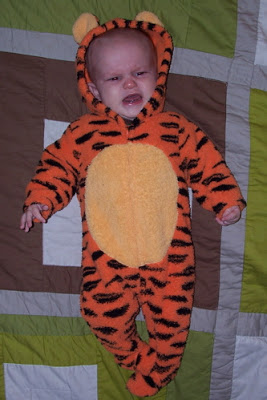
He is not CRYING, he is ROARING.
If you cheat, you are only hurting yourself. It is totally stupid to cheat on a diet. Who do you think you’re winning against? Like when your grandma was all indignant about some hoax she believed, so she boycotted KMart. But she didn’t even write KMart a letter to let them know she was doing it. Did she really think KMart was going to notice that they no longer got her $20/week? “Uh oh!” they’d say. “We must have pissed off Mrs. Rice! Let’s give her a call and find out what we’re doing wrong so we can stop doing it and make her happy!” NO. They didn’t even notice, and she had to find somewhere else to shop, where the prices were higher.
Don’t think about food so much. In theory, dieting should be easier than not dieting, because there are fewer choices, and fewer times of the day to be deciding what to eat. This should free up so much time. I said, THIS SHOULD FREE UP SO MUCH TIME. I cannot believe it—are you ALREADY thinking about what to eat next?
Remember to weigh first thing tomorrow morning, to get a starting weight. And write it in the Diet Journal—there’s still plenty of space from the last time you were writing in the Diet Journal. In fact, there’s probably no need to write in the Diet Journal this time: just cross off the dates from last time and write in the dates from this time. Saves paper! Saves time!
Think ahead about the times when you are likely to be particularly weak, and make arrangements. Like, when the kids go down for their naps and you would normally break out the contraband—I don’t think a vegetable platter is going to fill that void. Or what about after dinner, when you wash out the taste of dinner with something sweet? What’re you going to eat THEN, tough girl? FRUIT?
The journey of a thousand miles begins with a single step. What? A thousand miles? Nobody said anything about A THOUSAND MILES!! Let me off! Wait! Let me OFFFFFFF!!!!
I should be eating a dessert the size of my head right now. I’m not hungry for it now, but tomorrow when I’m looking back, I will be KICKING my last-night self for not eating whatever I wanted while I still could.
After the post I did about homemade baby food, there were requests for more info. And now suddenly I am a little anxious about seeming to present myself as some kind of expert, because here is how I got started making baby food: I read the ingredients list on a jar of Gerber peas and thought “Peas, water. I think I can combine peas and water for less than 50 cents a jar.” So I cooked some peas and ground them up with some water, and voila! Easy-peasy!
I did consult my baby-care manual first: it’s Caring for Your Baby and Young Child, by the American Academy of Pediatrics, and I’ve linked to the most recent edition but my copy is from 1998. Out of date much? But when I was consulting it in 1999, it was CUTTING EDGE, BABY. It said that the following foods should NOT be made at home because of possible high levels of nitrates: beets, turnips, carrots, collard greens, and spinach. Not that I would have been whipping up a big batch of turnips anyway, but it’s good to know. (I still use frozen mixed-vegetable blends that contain carrots.)
Here are some of the blends I make most often:
1) Mixed vegetable blends. Usually I get the kind that has green beans, green peas, carrots, and corn. Or sometimes I get a different assortment, like broccoli, cauliflower, green beans, carrots, and lima beans. Exciting!
2) Single vegetable plus single legume: green peas and chick peas, or green beans and kidney beans, or squash and great northern beans, or whatever. You can use dried beans, but then you have to soak them and cook them for a long time, so I use canned.
3) Mixed berries. The first time I tried this, it gelled up worse than jelly and was impossible to feed to the baby without re-blendering it. If you add some applesauce (about a cup) and some infant cereal (half a cup or so) to it in the blender, it will stay sauce-ish.
4) Chicken. Poach it (half-submerge chicken breasts in a lidded skillet of water and boil until cooked), cut it into cubes, and put it in the blender. I use boneless skinless chicken breasts. It blended up a LOT more easily than I’d thought it would. I freeze this in ice-cube trays because I want smaller portions. When feeding it to the baby, I mix it with a vegetable.
Okay! Answers to other questions:
The American Academy of Pediatrics manual says (keep in mind that my edition is ten years out of date, but I’m pretty sure this is the same as the leaflet the pediatrician gave me when the twins were babies) that at 8 months, babies can start having yogurt, cottage cheese, and cooked egg yolk. You can tip the raw white out of the shell and scramble just the yolk, or you can pick the yolk out of a hardboiled egg. This works out awesome if you yourself are on a diet and want only the whites.
I mix baby food with infant cereal and water: roughly half vegetable/fruit and half cereal/water. I started 6-month-old Henry on one meal a day of about a tablespoon of thin-applesauce-consistency food, and as soon as he got the hang of it I rapidly increased to a half-cup or so, and then to more like three-quarters of a cup. He’s nearly 8 months now, and recently I changed to two feedings a day of about a half cup each (more if he’s yolfing it down), and he’s eating it at more of a thick-applesauce consistency. I don’t think there are any firm rules on how much or how often or what proportions. I believe I must take it slower than average, based on the pediatrician’s mistaken assumptions about what the baby is eating.
The AAP book says that banana can be fed to the baby raw, but other foods should be cooked until soft, so I do cook fruits, yes, but not for long. (My guess is that there are other schools of thought on this, and I have no doubt the other schools are just as awesome and that their school cheers are just as peppy.) See above about adding applesauce (and I also add infant cereal) to the blender to avoid gelling. And don’t add much water to the cooking pan, because the fruit has a surprising amount of water in it.
I add some water to meat to make it blend smoothly, but I don’t add anything else to it. I didn’t even try meats until my third and fourth children, because it seemed so gross to do it (meat in the blender—-HORK), and also it seemed like the meat wouldn’t blend smoothly. But I used white-meat chicken and it blended gorgeously, and it was WAY less gross than those cat-food-scented jars of meat baby food. (And so much cheaper, you can’t even believe it.)
I’m not sure what the freezer lifespan is. We go through it pretty fast, so it hasn’t been an issue. My freezer says that soups can be frozen for one month, and that seems like a nice rough estimate–but I suspect the food would be fine for longer amounts of time.
No, I don’t make all my own baby food. I often buy the fruits, because it’s not as big a savings to make fruits. You can make a huge quantity of vegetables for cheap, cheap, cheap, but fruits are more labor and more money for less yield. I buy big jars of applesauce, and I mash up banana with a fork, and I buy a few jars of fruit baby food. I also buy carrot baby food, because of the nitrate problem my AAP manual mentioned. And I buy baby food to have on hand for convenience (especially with the twins, there were times when I ran out of chow), and for keeping indefinitely in the diaper bag. (The homemade stuff should be kept frozen or refrigerated until you’re ready to feed it to the baby.)
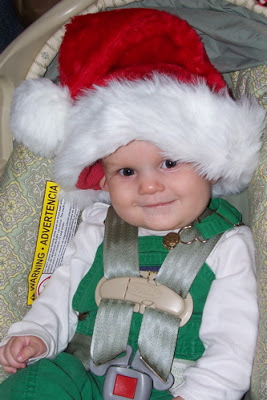
Speaking of out-of-date, here’s a picture of Henry from Christmas: