It has continued to feel odd, and I have continued to feel resentful about, going to a library not my own. It’s a smaller library, but it’s a member of the same grouping of libraries that shares materials, so I can still access anything in the same system. It’s been odd to need to drive to a library to pick up my holds, instead of just picking them up on my way out at the end of my shift. The new library doesn’t feel like Mine at all, but it is starting to feel like, for example, my third-favorite grocery store: I’m getting to know where things are, and there are a few small things that are an advantage over the favorite. The library workers are nice enough, but after a few attempts to start up those slight relationships, I’ve been using the self-checkout instead. It was too weird and cringe to deal with someone doing what used to be my job.
ANYWAY. I should have been keeping track, because I have been having parallel reading streaks of HUGE SUCCESS and ABSOLUTE FAILURE, one after another in both streaks, and always too many books in the piles. I’m trying to remember what I’ve recently checked out and returned, but there have been like EIGHT where I gave it a good 30-50 pages and then gave up; and a couple more where I read a page or two and thought NOPE.
Oh! I tried one that so many people have recommended, and I have forgotten the title and author, but it involves two young attractive and charming gentlemen, and an alternate universe including bureaucratic magic, and a delightful and heart-warming enemies-to-lovers trope. But WAY too early in the narrative I got to a point where one of the charming gentlemen referred idly and casually and non-plot-essentially to, forgive me for making you read this, his c*ck twitching, and I fully noped out at that exact moment. Just no thank you to all of that.
I tried a “summer read” by a local author, much lauded and also thrillingly chosen by one of the celebrities who has a book club, and I don’t remember why I almost immediately rejected it, but I almost immediately rejected it. Then I repented of my haste, took it back out of the return pile, and tried it again, REALLY TRIED, several dozen additional pages. Still no. How nice to get it briskly to the next person on the LENGTHY hold list!
There were two non-fiction books, one about laundry and one about being a daughter—both of which appealed to me, and neither of which I could get through, or even into. I tried skipping and skimming ahead to the good parts and that still didn’t help.
I tried Kitchen Confidential, after seeing so many positive reviews about the author’s heartbreaking story and how wonderful a person he was, and I could not get into it, and in fact felt increasing rage at his stories of how cool it was that the mostly-male kitchen staff got to drink and do drugs and have sex with every “waitress” and many of the (female) customers, and how much he wanted to be part of that world, and how he achieved it—peppered with his Best Chuckling Anecdotes about, for example, how the whole staff saw a literal bride on her wedding day having sex with the head chef out behind the restaurant, describing the bride as “bent obligingly over a trash can” or whatever it was (I returned the book before recording the exact quote, so that is from unwanted memory), and how THAT was the moment he thought I WANT TO BE A CHEF—no thank you and gross, and I don’t even want to know how many times he’s told that story, or what sort of reaction he thought it should get.
In book successes, I am on the final book of a trilogy, each book of which is the thickness of a loaf of bread and the weight of a bag of flour: it’s the Fitz and the Fool trilogy by Robin Hobb. And I DEEPLY NEEDED the MULTIPLE SWOONINGLY FERVENT recommendations I had seen for this series, because the first 100 or so pages of the first book were ROUGH. All “and, half-dressed in my leather deerskin trousers and with loose white blousen unbuttoned, I strode to collect my sword and paellis, feeling The Swift upon me, as in days of old, for I was one of the Spox’eni and could hear the ancient stones, and…” and whatever. Good lord. Insufferable. Just tell us what’s happening, and do it normal. Look at the cover:
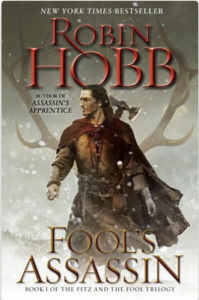
Does this look like a book your Swistle would enjoy?
But I persevered, and if I remember correctly it was right around the hundred-page mark that I found a plotline that seized my attention. And then Edward had his surgery, and I was keeping him company in the hospital for days, with hours and hours of time on my hands for reading, and it was good to have a plentiful supply of material. There were still FAR too many sentences that started with “For,” and FAR too much maudlin wallowing. The main guy has some significant mistakes and losses, and let’s say you would be willing (even EAGER) to hear him regret and rue those mistakes/losses for, say, X times; the book has him regretting and ruing 20X times, so that you will be skimming and thinking “My good sir, WE KNOW, could we GET ON WITH IT”—and, after awhile, it will be so many repetitions that you will stop looking at the character and start looking incredulously at the author. And also: in general we dwell too much on This Guy and his perspective and experiences, and on his imprecisely-intimate special friend (a lot of tell-don’t-show with that) and that special friend’s health and trauma, when the real interesting character to me was the one who grabbed my interest at around 100 pages in. Here I am, though, looking forward to the third cement block of the series, so.
MEANWHILE: waiting for the third book to be delivered to me from another library in the system, I saw a mention online of the book Spindle’s End, by Robin McKinley.
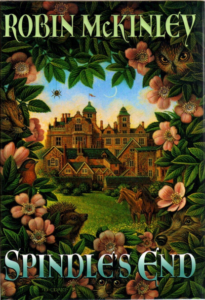
(image from Amazon.com)
The mention included an excerpt (a photo of the first page), and I read it, and I was grabbed. I was surprised, when I requested it through the library, to see it was categorized as YA. I would like to like YA, but I have given it many tries and I almost never like it. I did like this book, and I didn’t see any reason why it would be categorized as YA. Okay, it involves an Ordinary Youth finding out that they are in fact Very Very Exceptionally Special; there were also some parts where something was obvious, and it was for some reason not obvious to the characters involved, and it kept being Not Obvious to them LONG past the point of credulity. But none of that is exclusive to YA! In fact all those things happen in the Fitz and the Fool trilogy I was just talking about, especially the part where something Obvious keeps being Not Obvious to the characters, to the point where I wondered if the author were concussed! (…I realize I am not selling the series here, so you will have to trust that no one reads three books of 800+ pages each unless they like them very much.)
Anyway, I found Spindle’s End enchanting. It’s a retelling of a fairy tale (Sleeping Beauty), and that is a category of book I am so sick of, but I’d loved the excerpt I read, so I tried it anyway, and I’m so glad I did. There were some satisfying resolutions (and initiations) of plot issues that left me WEEPING. I will read more by this author. Well, I will read more by this author when I am finished with the third book of this other trilogy, which will be in weeks and weeks. Could an editor have simply carved away SOME of the…?
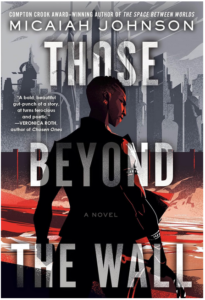
While waiting for Micaiah Johnson’s new book The Unhaunting, I read her book Those Beyond the Wall and really liked it.
(image from Amazon.com)
Dystopian, violent, but relationship-based. If you liked The Space Between Worlds: this is a stand-alone, but it takes place in the same time/world, with some of the same characters. I found it less mind-blowing than The Space Between Worlds, but that’s often true of the second book in the same world. Do you like enemies-to-lovers? So does this author, but nobody’s anything TWITCHES.
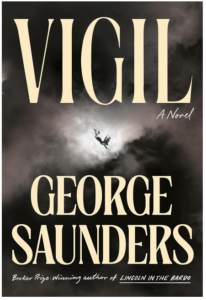
Like EIGHT YEARS AGO I read and enjoyed Lincoln in the Bardo by George Saunders. On a recent library trip I saw his new book called Vigil, and I liked the description (another afterlifey plotline) and checked it out.
(image from Amazon.com)
I did not SOB as I did while reading Lincoln in the Bardo, but I liked it a lot. It is very Of The Moment, if you can tolerate books that are Of The Moment. A spirit is on a mission to comfort the dying, and she is paired with a dying oil baron, and she finds the task…challenging. There are many paragraphs of him justifying the terrible things he has done to the world by his actions and, even more so, by his marketing spin, convincing others that climate change is nothing to worry about. …I’m talking you out of reading it. It is MORE focused, I would say, on the spirit, and on the intrusive thoughts she has of her own life, while she is trying to be spiritual and otherworldly. Well, no, it is more focused on the way someone who has sold his soul for money and power KNOWS he has done wrong AND ALSO justifies that wrong—and HOW he justifies it, and how ugly that justification is. It was satisfying to read, while also making me angry-cry.
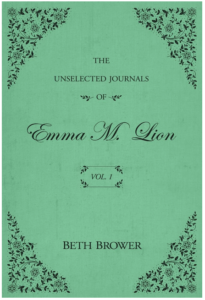
SO MANY PEOPLE recommended The Unselected Journals of Emma M. Lion series, it’s amazing I could even try one—but the buzz got to me, and I tried one. In fact: the waiting list in my library system was so long, I BOUGHT the first one, IN HARDCOVER, so that I could donate it to the library system after I finished it, since they obviously needed more copies.
(image from Amazon.com)
I thought it was lightweight and silly, and that the plot/characters were ridiculous to the point of being annoying/nonsensical. I donated it to the library with no feelings of wanting to keep it. Then I kept thinking about it. Then I put the second one on hold and, after a few weeks of waiting, BOUGHT THAT ONE TOO, and read it, and donated it to the library as well. The hold lists for the third and fourth volumes were much shorter, and since I’d put myself on hold for those at the same time as I tried to reserve the second volume, I got them not too much after I was ready for them. Now I am on hold for volumes five and six.
It IS a silly story. The plotlines ARE ridiculous. But it is also sweet and funny, and I enjoy the unabashed selection of stereotypical love interests: there is the serious young fiery minister, the handsome scoundrel, the terrible tormenting boy from her youth who grew up to be hot and nice and rich, the brooding artistic tenant, the literal handsome duke, and so on. Just love interests as far as the eye can see, and how fun for us all. I don’t think I will want to watch the inevitable TV series, though: the main character is just a little too quirky and messy-haired and whoops-did-I-say-that-out-loud, and I don’t want to see that in motion.