I VERY MUCH ENJOY sending Fresh Cut Paper paper bouquets. They usually cost in the $12-15 range, and they take four regular stamps to mail, and they’re perfect for things like “aunt’s 80th birthday,” where you want to send something kind of fancy and special but also it can be thrown in the recycling when they’re done looking at it. Or, if you are me, you got one from a friend and it’s still whimsically/beautifully decorating your bookshelf a year later.
If you haven’t encountered these things before: there are a ton of different kinds, but here are a few samples:
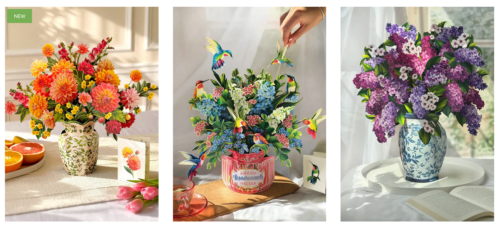
(image from freshcutpaper.com)
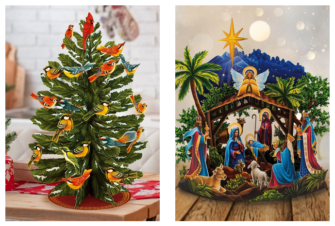
(image from freshcutpaper.com)
They’re folded flat for mailing, and then you pull on them a certain way and they go 3D. And sometimes there are sales, like 30% off certain bouquets, or 50% off all Christmas, or whatever. All of this is to tell you that while I don’t mail these constantly, I do mail them from time to time, and I find it very fun. I sent one of the Christmas trees (the one with an ornament pack rather than the one with birds) to Rob for his first Christmas in a studio apartment far from home.
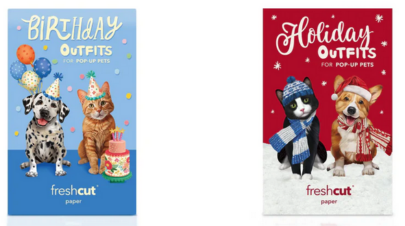
The company came out with a new line of 3D ANIMAL cards, with little accessory packs so the animals could be decorated for birthdays and holidays.
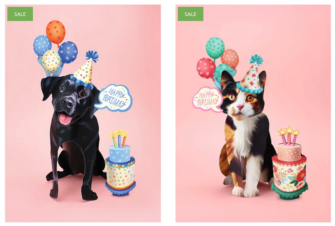
(image from freshcutpaper.com)
(image from freshcutpaper.com)
I hadn’t bought any of them, because they had like half a dozen different cats and a dozen different dogs and I felt it was too hard to choose: do I match the animal to the RECIPIENT’S animal? What if there’s no animal close enough? Would most people prefer 3D paper flowers over a 3D paper animal? Etc. Then I noticed they were clearing them out and they were 50% off, and I tried not to lose my mind. I reminded myself that I tend to HOARD things like this, “saving them for special.” I pre-scolded myself that if I wanted to buy these, I needed to ACTUALLY SEND THEM—ideally all within a year, so I wouldn’t have to wonder if I’d already sent someone one on their previous birthday. I bought what I considered a REASONABLE selection. Let’s not actually count up how many; let’s just say it was REASONABLE, considering how much I like sales and how much I like sending cards and how much I like sending THESE cards. I bought some birthday ones, but I mostly bought Christmas ones: I love sending Christmas cards, and I thought it would be fun to send these to the families I know with younger kids.
Today, taking the pre-scolding to heart, I am already mailing the first of the birthday cat cards—only a week after the box arrived, so that is PRETTY GOOD. Instead of the usual message in the stamp section about needing four first-class stamps, there was a QR code. I used the QR code, and it said if I was mailing a cat card, it would need four first-class stamps; if I was mailing a cat card WITH BIRTHDAY ACCESSORIES, I needed to consult the USPS. I stopped by the USPS and consulted. It will cost SEVEN DOLLARS AND NINETY CENTS to mail. This is an ENVELOPE. But the birthday-accessory pack means it does not technically qualify as an envelope and now qualifies as a package, and it costs EIGHT DOLLARS to mail it TO THE NEXT TOWN OVER.
Remember I mentioned that it normally takes four regular first-class stamps to mail one of these. That feels right to me, and I don’t do the math. Let’s do the math right now: at the current rate of $.78 per stamp, it’s $3.12 to mail. Fine. I liked it better when I hadn’t done the math, but fine. The birthday/holiday-animal cards cost MORE THAN TWO AND A HALF TIMES THAT AMOUNT to mail. No wonder they are clearing them out! No wonder!!
I took the envelope back home with me to think. There are a couple different things at play here. One is whether I want to spend eight dollars to MAIL a birthday card. Another is how the recipient will feel, seeing that I spent eight dollars to mail their birthday card. And keep in mind that I have ALREADY PURCHASED MANY CARDS. That is of course a sunk cost—but I feel it’s worth unsinking if possible: I still love the cards; I still feel the recipients will like them too; I’d still like to send them.
In today’s particular case, I COULD hand-deliver the card. That saves me eight dollars. But I do feel cards are better and more special when they arrive in the mail. Do I think they are EIGHT DOLLARS better and more special? I’m leaning no. And normally I CAN’T hand-deliver, so this question won’t apply to MOST of the cards I bought anyway.
I know when I pre-pay and print postage from the USPS website, there’s an option to hide the amount and not print it on the label. I could do that. I still pay the money, but we remove the issue of the recipient knowing how much. And since I bought the cards at 50% off, I could choose to see it as me spending roughly the same total mount as if I’d bought the card at full-price but then got the shipping for free. If I’d seen a deal where the animal cards cost full price but came with free-shipping vouchers, I would not have bought AS MANY, but I would have bought SOME.
I could mail the birthday accessories separate from the card. It looks like the accessory pack, which weighs so close to just-over-an-ounce it’s ridiculous, would take a second-ounce stamp to mail—so, $.78 plus $.29, or $1.07. Then the cat card would ship for $3.12, and the total would be $4.19 instead of $7.90. That’s a pretty good savings! I would definitely have thought it was reasonable if I’d had to add 1-2 stamps to the big envelope in order to add the accessories. But it means the two pieces arrive separately, possibly on different days—and, with the USPS as it currently is, this doubles the chances that one piece gets lost or arrives three weeks later. And even if they arrive together, I’d say it definitely lessens the overall impact of the card.
I could look into whether I could do things to make the whole card weigh less and go back to qualifying as an envelope. For example, I could remove the birthday accessories from their separate envelope before adding them to the main envelope. I doubt that would make enough difference—but considering how close the accessory pack is to one ounce, my suspicion is that Fresh Cut Paper did not take into account the postage situation when they were designing these. It’s possible we’re within a fraction of an ounce of making this work. …Okay, I weighed it and it is 4.6 ounces; an envelope becomes a package when it weighs over 3.5 ounces; I would have to remove the entire accessory pack to turn it back into an envelope, so that’s not going to work. Hm.