I am cranky at a book. It’s The Fates Will Find Their Way by Hannah Pittard, and it’s probably not the book’s fault.
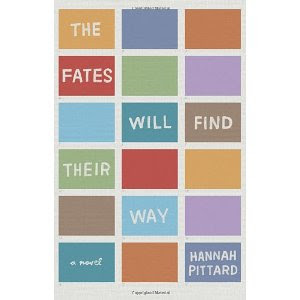
Isn’t the cover pretty? It makes me want to paint some of those colors on walls.
(photo from Amazon.com)
The thing is, I like books WRAPPED UP. I want loose ends TIED, and I want mysteries EXPLAINED. I like to know WHAT REALLY HAPPENED. Which reminds me: I’m cranky at another book, too. It’s The False Friend, by Myla Goldberg.
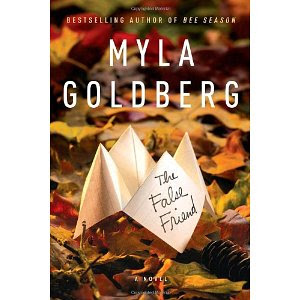
(image from Amazon.com)
If a book uses a BIG MYSTERY (in both books, a missing girl) for its momentum, then at the end I want to know the whole story. I don’t agree with readers who say “Well, but in REAL LIFE we wouldn’t know!” This is not real life, this is fiction, and I want to know. If I don’t get the answer, that says to me that the author didn’t know either: she just wrote it all mysterious-like to make it suspenseful, but she took the lazy way out and didn’t find a way that all those clues could make SENSE. I once emailed Jodi Picoult to DEMAND the answer to a mystery she left unsolved in one of her books, and she emailed me back that the ending is what we make of it. NO. The ending is what the AUTHOR makes of it. That is the author’s job. My job is to read it.
The Fates Will Find Their Way is distinctive for two reasons:
1. It is written in first person plural (we thought this, we did that). This is such an unusual style, I was constantly thinking of the only other book I’ve read that used this style (Then We Came to the End, by Joshua Ferris, a book I thought I hated for the first fifty pages, after which I loved it). It is a VERY STRANGE style.
2. Even more distractingly, it’s a female author writing on behalf of a group of boys/men. I ALMOST ALWAYS hate this. My attitude is “You have failed to acquire authorization to represent this point of view.” You’d think I’d feel that way about ALL books with non-author narrators (“Who are you to write as if you were Mary, Queen of Scots??”), but I don’t: it’s the male/female thing only. I think it’s because that is SUCH a minefield already, what one sex assumes the other sex is thinking and feeling. I feel it less with a female author and a male narrator, of course, because I’m not personally offended when a woman makes assumptions about how a man’s mind works—but I still think, “Hey.” And I wince if it seems personal/private and negative. Since this particular female author is writing for a whole GROUP of men, I was even more sensitive to it: by attributing thoughts/feelings to a group as if there was consensus to support her claims, it was more serious than if she were claiming it only for one character.
Both books deal heavily with teenager stuff: teenage emotions, teenage cruelties, teenage traumas. The Fates Will Find Their Way deals CONSIDERABLY MORE with teenage sexuality than I would like to read about (this was one of the parts where I repeatedly thought the author should not be writing on behalf of the opposite sex); The False Friend put more emphasis on teenage cruelty. Both books made me feel uneasy about my own children entering this age.
Both of these books held me absolutely riveted, and neither one of them paid off in the currency I prefer to tender. If you LIKE books that reflect real life, in that they leave you hanging and you never find out what happened (I’ve seen reviewers saying they liked the food for thought, or enjoyed the way it made them reflect upon the mysteries of life and how little we know about the Truth, etc., etc.) (though, I find it possible to THINK without the element of CONFUSION present), then BY ALL MEANS you should read these because they were GREAT until they omitted their satisfying-resolution, mystery-finally-revealed endings.