I know Tessie likes health kick talk, so I will talk about this book here instead of squirreling it away for private consumption.
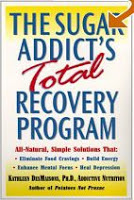
(image from Amazon.com)
I read The Sugar Addict book a number of years ago, liked it, started following the advice in it—but gained ten pounds and dropped the whole system like a night potato. [Little joke interpretation for those who have not yet read the book: the author recommends eating a potato each evening.]
Now I’m re-reading it, and I’m finding it re-awesome and thinking of re-trying it. A lot of it is what I’m trying to do ANYWAY on my diet: eating protein for breakfast, eating more whole grains, eating more vegetables, eating less sugar. And perhaps this time I won’t go around saying, “Hey, fast food is high in protein!”
Here are the things I like/dislike so far, partway through my re-read:
I like:
1) The idea of sugar as a substance that can be abused. I find it helpful to think of it not as an inherently bad thing, but as something that can be used normally (the equivalent of a drink with dinner) or not (the equivalent of needing five or six drinks to feel anything at all).
2) The idea that some people have a problem with sugar, and some don’t. I find it helpful to think that just as some people can’t have a drink with dinner without finishing the bottle later that evening and going out for a fresh bottle the next morning, some people can’t handle their sugar normally. I have had the same bottle of vodka in my cupboard for over two years—but if that were a bag of candy, I’d think of it night and day until it was gone. Different people struggle with different things.
3) The gentle, comforting tone of the author. She sounds like she’s talking to a frightened wild animal, and she knows how to release your leg from the trap.
4) The way she really seems to understand what this is like. She doesn’t say, “Just stop eating sugar, you idiot!” She knows it can be a lot harder than that, and she has steps and tips and practical ideas.
I dislike:
1) The idea of sugar as a substance that can be abused. I feel uncomfortable comparing a sugar addiction to a drug or alcohol addiction. Sometimes it feels like when someone is talking about how they were only 5 years old when their mother died, and someone else says, “Oh, I totally know what you mean: my grandma died when I was 25 and I was SO BUMMED.”
2) The idea that some people have a problem with sugar, and some don’t. I really DON’T want to go around explaining to friends and family that sugar is like poison to me, or whatevs. *EYE ROLL*
3) The gentle, comforting tone of the author. Sometimes it seems soooooooo self-helpy, I feel silly reading it.
4) The way she really seems to understand what this is like. When she’s right, it IS pretty mesmerizing—but when she misses her guess, I feel out of place and awkward, like a fortune teller is telling me things about my life that aren’t true (“You will have only one chiiiiiiiild! And you will never marryyyyyyyy!”).