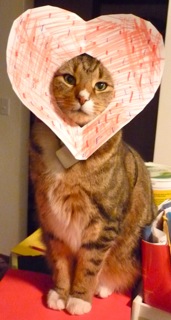
I keep mentally composing more posts about Benchley’s sad end, but not wanting to seem as if I don’t have this in perspective. That is, I can think of many, many life circumstances I could have endured that would make me want to shake someone who was going on and on about a cat.
This, though, is the perfect place for the Hopkins couplet carefully learned in high school English class: “It is the blight man was born for, / It is Margaret you mourn for.” If you daydreamed about cute classmates through that class instead (and who could blame you with all the twisty poem phrasings to untwist), the poet is telling Margaret that when she’s sad about things dying/ending, what she’s actually sad about is her own eventual unavoidable death.
It’s not that the death of a cat is so extremely terrible on the spectrum of terrible things, it’s more that it can bring to the forefront of the mind all those things further up on the spectrum. So it’s that I’m sad because our cat died, but it’s also that I’m horrified to realize that DEATH IS REAL, IT ACTUALLY HAPPENS, IT WILL HAPPEN TO ALL OF US AND IT MIGHT NOT BE A PEACEFUL OLD-AGE DEATHBED SCENE EITHER BECAUSE TERRIBLE DEATHS HAPPEN ALL THE TIME. I know this already, but it sits on the surface of my mind like oil on the top of water: it’s RIGHT THERE, but it never sinks in.
It’s been large-application horrifying to realize how many death-related thoughts end in “Well, but at this point it’s irrelevant.” My worst fear is that Benchley was injured but not killed by the car, and then died because we didn’t find him in time—maybe after quite a long time of lying there suffering. It’s newly startling to me each time to work through that chain of upsetting thoughts and run right into “But at this point, it’s irrelevant. Either way, it’s over.”
It’s a comfort in some ways (he and others are not suffering NOW, even if he and they suffered THEN), but a horror in other ways: THERE IS NO GOING BACK, EVEN IF A DIFFERENT PATH WOULD HAVE COME OUT DIFFERENTLY. And this happens with so many things: every thought path where things could have gone a different way (if he’d happened to take a longer nap before going out, if the car had seen him in time, if the car had left one minute earlier or later that day, if we’d been on the scene when it happened, if our cat Feather could have communicated to us where he was) or where there is an objection to his death (but he was so young/healthy/strong, but he was so scared of the road and didn’t go near it, but it was so much more likely that he was just trapped somewhere, but I didn’t expect it, but it was just an ACCIDENT)—ALL of them end the same way, with irrelevance. It still did happen the way it did happen; he is still dead.
The way the body lingers awhile seems crazy. When we found Benchley, he looked like himself. There was his fur, still glossy and plush and familiar. There was his ear, still a thin triangle with a fluff of fur inside. There were his whiskers, still sticking straight out. There was his tail, fluffy as usual. It’s hard to accept it: we look at a body, and our eyes/brains are telling us two different things simultaneously: “There he is” and “No, he isn’t.” Instead the body should vanish, or turn instantly to dust like a staked vampire on Buffy. The slower route is horrifying and comforting, showing us that the same materials just cycle around endlessly, that nature is busy all the time taking care of it. But the sudden disintegration would make more sense.
While not wanting to reduce a pet’s existence to “being something that makes a person go ‘hmmm’,” I can see how one of the many good things about having pets (let’s save the many bad things, such as peeing on things and needing expensive medical care, for a less emotionally vulnerable time) is that they provide us with opportunities to get used to…well, to Margaret. Or to an important relative of Margaret’s. As a parent, I’ve been finding it tremendously helpful to have this chance to explain things I hadn’t realized the kids were wondering, or to correct things I hadn’t realized they’d thought. And to give them as gently and lightly as possible their first exposures to a message we all need to understand but that I don’t want to tell them: “This happens to everything. (This will happen to you.)“