Category Archives: Uncategorized

The Ideal Birthday Party Invitation

The ideal birthday party invitation for a child’s party would contain:

1. Name of child (with surname), and address of party location, and date of party, obvs.

2. Time of party—and this may seem like another for the “obvs” category, but I’m listing it on its own to specify start time AND end time because the two party invitations we got this week only have a start time.

3. It doesn’t have to be a lengthy minute-by-minute thing, but a GIST of what is going to happen at the party. Whether it will be indoors or outdoors, so I can make decisions about sunscreen and tick repellent and outerwear. Whether food other than cake will be eaten, so I can make decisions about what to feed the child ahead of time. Whether it’s one of those big family-reunion-type parties with a few school friends also invited, so no one is watching the kids because everyone’s catching up and no one knows who belongs to whom, so I’ll need to bring a book and stay. Plus, some of my kids are the anxious type, so this lets me prepare them a little ahead of time for how things are likely to go, and to review any safety/politeness rules that might be specific to the type of party.

4. For younger children, a line about whether parents should expect to stay or leave, or whether it’s completely up to them.

5. The parents’ names, especially if there’s only a phone number for R.S.V.P.ing.

6. If there is ANYTHING WEIRD about the location, DETAILS about that. Especially for apartment complexes: parking instructions, which building to go to, which door to go in, which button to press to get buzzed in (“Hey, these are all surnames! None of them say ‘Jonathan’s apartment’!”).

7. An email address for R.S.V.P.ing, I beg of you. I BEG OF YOU.

The Critical Eye

I hadn’t realized how many novels have characters who casually or seriously evaluate/criticize their parents until I found myself getting worn out with all the mental arguing I do with them: “Well, you know your parents were HUMAN, right? I mean, they absolutely HAD to have SOME flaws, and these were the ones they happened to have. Would you have preferred DIFFERENT flaws? No you WOULDN’T have, because if they’d had THOSE flaws you would have criticized those TOO. It’s not as if your parents COULD have been perfect if only they’d TRIED. What is it you expect them to DO with their flaws, anyway? You think that just because it would have been better for YOU, the child, if your dad didn’t have a short temper, that he could have easily and completely pulverized that part of his personality? ‘Oh, it’s better not to struggle with temper! I’ll just STOP DOING IT, THEN!’ And what about your criticisms of things that aren’t even flaws? You think that just because you would have preferred the kind of mom would would RUN and LAUGH and PLAY just like a golden retriever, that she could have changed herself from the quiet, bookish, indoorsy type she was? And you think that she SHOULD have? Why shouldn’t YOU transform YOUR active, social, outgoing personality into a quiet, bookish one? Does THAT make any sense to you? NO? You see how ridiculous that line of thought is, then! Why not focus on what your parents did RIGHT, instead of what they did WRONG? Or on the ways they were a GOOD fit for you, rather than the ways they were a BAD fit for you? Why not see if you can bring yourself to realize that your parents had the same limitations as any other human being, and were not required/able to be custom-made to your rigid specifications? Why not meditate on the idea that they didn’t choose your temperament any more than you chose theirs, and that ALL parent/child relationships are a total crapshoot and we’re lucky any of us get along AT ALL beyond the biological instincts to love each other? GEEZ.”

Ahem. I may be a little touchy on that topic recently, with a teenager in the house.

It’s been hard having that kind of light turned onto ME so fiercely. Every book I read reminds me of how he seems to see me at times: as someone who at every turn should have made a different decision; as someone who is willfully unfair; as someone who willfully fails to control her flaws and is not sorry about them and doesn’t even TRY to change; as someone who COULD be perfect if I’d bother to TRY. It seems like so often he chooses to see me in the worst possible light.

I’ve gradually realized the only way to escape that variety of critical stare (their eyes! like gimlets!) is to die relatively young so they instead idolize me and pine for me and speak only of my virtues and how much they miss me and wish they could talk to me. Which reminds me of those things older people say when you ask how they’re doing: “Better above ground than below it!” “Welllll, can’t complain—it’s better than the alternative har har!” “The only way to get my kids to remember me in a glowing light is to die young, so I guess this is better than that har har!” Har.

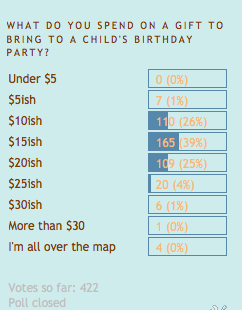
What Do You Spend on a Child’s Birthday Party Gift?

I have noticed that there are times where I am going around thinking $x is the right amount to pay for something, and then I find out that everyone else considers even $2x to be totally cheapo. Haircuts can be like this: I think of myself as paying kind of a lot for a haircut, not a ton but not cheapo either, but it happens repeatedly that I will hear someone say “I’m never going to get around to going to my usual place, so I’m just going to get a cheapo $2x cut and hope for the best”—where $x is what I pay for a haircut. That kind of thing.

Anyway, what I’m wondering about is birthday party gifts you’d bring to someone else’s child’s party (not for a relative of yours, but for, like, your child’s classmate). I definitely don’t want to be cheaping out on that, but I don’t need to bring the most expensive gift of the day, either. And I’d like to be SENSIBLE about it: we generally don’t know the child’s current toy inventory/preferences, so what we get could easily be a duplicate or something they don’t like. So even if I found out that everyone else was spending $20-30, I might still stick with what I currently spend, which is “about $10.” I will spend a little more for the perfect thing, but I was going to put a range there, and I’d thought “$8-13,” and then I realized no, I don’t think I’d spend $13 unless it was really truly irresistibly perfect—and it’s rare to know such a thing about someone else’s child.

Anyway-again, what I think is useful for these sorts of things is a POLL (over in the right-hand margin). [Poll closed; see results below.] But I also like the comments section, because I like hearing people say the DETAILS of they do: “Well, for someone we don’t know, I spend $x; but for close friends’ kids, I spend more like $2x” or “I let my child choose a gift, and anything up to $20 is fine” or “We’ve been spending $30, but that was when we hardly went to any parties; now that the kids are getting invited to more, we have to cut it back to more like $15” or “I don’t have a plan: sometimes I spend $5, sometimes I spend $40” or “It depends on the location of the party: if it’s a home party I aim for $10, but if it’s a big exciting place I aim for more like $25” or “Well, we MAKE gifts, so it’s harder to figure out, but probably $5 for the materials, and the result is the equivalent of a $15 gift.”

(If you’ve never had to bring a gift to a child’s birthday party, you can answer with what you think you’d be likely to do.)

Cranky Books

I have read THREE books in a row that made me cranky.

ONE: A book that was on the Librarian Picks shelf. It was apocalyptic fiction, which means it goes in my library bag whether or not it’s on the L.P. shelf. Then I read about 3 pages, thought, “What on earth is going on here?” and checked the cover to read the plot summary again to try to remember why I’d chosen it—and noticed it was published by a Christian publisher. Ah. That explains it. I tried another few pages just in case, but no. Apocalyptic fiction can have religious themes, and it can even have a subtle message (“Look what will happen to us if we don’t stop experimenting with crop chemicals!”)—but it’s ruined if it’s PREACHY.

TWO: Then I read Dan Chaon’s Stay Awake, which is a book of pleasingly creepy short stories. I liked them very much, but they were kind of sad (lots of stress and death themes), and I couldn’t figure out what was going on in ANY of them. So again and I again I was in a state of unsatisfied suspense, which made me feel irritable and stupid. Then I spent a couple of hours online trying to find stuff written by people who HAD figured them out, and all I could find was (1) one hint that did in fact let me figure out one single story—making it feel as if I should be able to figure out all the others, and (2) a lot of people saying most stories COULDN’T be figured out, which made me cranky because I don’t like to be toyed with like that, plus I was frustrated because I’d wasted so much time looking for something that didn’t exist.

THREE: Then I read a book that I NEVER would have chosen if it hadn’t been on the Librarian Picks shelf, and this book CLOSED THE DOOR on the L.P. shelf for me. It was narrated by a dog. The dog had a lot of insightful observations to make about human beings (we should listen more! we only get sick and die because we BELIEVE we will! and we should live in the NOW, just like the racecar driver who constantly anticipates the future and repeatedly watches tapes of the past! …wait, what?). And it was sentimental/weepy fiction written by a man. Some people right now are going to want the name of the book because this is exactly their thing; for me, that is like the perfect trinity of unreadability. AND YET I READ IT ALL THE WAY TO THE END because I had to know how the unearned-suspenseful plot was going to resolve, so then I felt irritable and crabby but had only myself to blame. That’s an unhappy place to be, let me tell you.

No, wait, it’s FOUR cranky books, because before these three I read Unorthodox!

Now I’m reading Richard Russo’s Bridge of Sighs, and if I don’t like it I’m going to spend the weekend reading People magazine and watching television.

I Didn’t Sign Up For This

Here is a recurring life problem I have not yet figured out how to handle: If you sign up to do something, but then you get the response last-minute and/or for something other than you thought you were agreeing to, but at this point backing out will cause other people some level of hassle—how do you deal with it gracefully? And by “gracefully” I mean “So that they fully realize it’s their fault, not yours?”

Like, let’s say several weeks ago you filled out a form saying you’d be happy to contribute an item to the Teacher Appreciation brunch, which the form doesn’t give a date for. The form says someone will contact you to arrange what you’d like to bring. But then the first you hear back, it’s “Great! Can you bring peeled, sliced, hard-boiled eggs and washed cut-up cauliflower for 45 people tomorrow morning? On trays, thanks!” And YOU’D been thinking that when you were contacted to see what you’d like to contribute, you’d say muffins; and you have no idea how much egg and cauliflower would be enough for 45 people, and you’ve never bought cauliflower in your life, and you can never get hard-boiled eggs to peel right, and you would have to drop today’s plans to meet this request? WHAT DO YOU DO?

What I did was reply that I was sorry but I wouldn’t be able to do that by the next day. I didn’t give excuses or explanations, or get into what I would have chosen to contribute or how I felt about peeling eggs, I just said I wouldn’t be able to—though I think “by tomorrow” implies the basic reason. And then I agitated and suffered, because I’m imagining that the person who contacted me will see this as “bailing,” or wonder why I would sign up to do something I couldn’t do. So I’ve been having all these imaginary conversations with that person, where I explain that the form didn’t indicate that I’d just be ASSIGNED something, and also that I don’t think one day’s notice is reasonable, and also that hard-boiled eggs AND cut-up cauliflower seems like a lot to assign to just one person, and also that maybe it would be better to say how much food (e.g., “a dozen hard-boiled eggs and a head of cauliflower”) rather than how many people, since probably MOST people aren’t familiar with catering-type estimating, and also we don’t know how many other foods are going to be there. —Like that, but on and on because the other person is completely in my head so I get to deal with an endless stream of their imaginary unfair objections, accusations, and assumptions.

Anyway. It’s the sort of thing I don’t run into ALL that often, but nevertheless regularly over the years. When it happens repeatedly from the same source, I know to just stop signing up for things, or to clarify a few things at sign-up time. I stopped doing a writing job because it happened so consistently: they’d ask if I was interested in writing on a topic; I’d respond yes; and then I’d hear back three weeks later that they’d need a draft the next morning, thanks! I felt like I had SAID yes so now I needed to follow through—but that I WOULDN’T have said yes to THIS.

The problem is that it’s usually less consistent/predictable than that, and it’s usually coming from many separate sources—and/or else it’s something I don’t WANT to get out of, like contributing things to the kids’ schools.

I guess the answer in general is that it would be a good idea to make some clarifying comments at sign-up time. For example, on school forms I could check the box saying I’ll donate something, but then ignore the part about choosing something later and instead write “I can bring a dozen muffins” or whatever. That doesn’t solve the problem of if they then contact me the night before (although I guess I could add something like “I’d need a couple days’ notice”) or if something else happens that I didn’t realize would be an issue I’d need to anticipate—but thinking over the issues I run into most often, it seems like it would significantly reduce the problem.

Weight and Daughters

I’m distressed because this evening Elizabeth mentioned that she hoped she wasn’t going to gain any weight. Context: she outgrew all her pajamas and pants all of a sudden, and she’s been extra hungry, so I mentioned that she must be having a growth spurt. She wanted to know what that was, so I told her that children often seem to grow all of a sudden, in bursts. That’s when she said she hoped she wouldn’t gain any weight.

You are going to have to take my word for it that I don’t say negative or positive things about weight where she can hear me. I don’t lament the way I look in my clothes. I don’t mention gaining or losing weight. I don’t verbally admire thin people. I don’t call certain pants my “fat pants,” or wonder aloud if I look fat/thin in what I’m wearing. I don’t talk about foods being fattening, or having a lot of calories, or having fewer calories. I use the word “healthy” to describe health states (“I’m so glad we’re all healthy again after that long winter of strep!”), not as a synonym/euphemism for eating less food, eating lower-calorie food, losing weight, or being thin. I don’t mention diets, or restricting eating for purposes of weight loss/not-gain, or not eating something because “I shouldn’t” or because “it’d go right to my hips.” I don’t have friends or relatives who come over and do these things. She watches PBS—no teen-girl-type shows.

I exist as a plump person. I don’t mention being a plump person, or anything about being a plump person, or anything about what size I am or what size I’d prefer to be. EVER. It’s not that I say it only to Paul or to a friend when I hope we’re not being overheard, and then perhaps if this were a book we could illustrate this statement with a little sketch of the impressionable young girl listening unnoticed at a doorway; no, I am telling you that I NEVER MENTION IT AT ALL IN ANY CONTEXT WHEN I AM WITHIN A MILE OF HER.

Nevertheless, she is six years old, and she is so far below the average weight for her height that the pediatrician mentions it at each visit, and she doesn’t want to gain weight. She’s mentioned this a few times recently, but I’ve ignored it because I didn’t want to draw a lot of attention to it—or more truthfully, because I didn’t know what to say. This time I asked soooooo casually if the other girls at school talk about gaining weight. She said no. I asked if anyone else had mentioned it. She said no. I asked why she said she didn’t want to gain weight, and she laughed nervously and said, well, she meant she didn’t want to gain TOO MUCH weight.

I didn’t pursue it any further. There isn’t any point. It’s not as if it’s possible to rear a daughter who doesn’t understand that this society expects her to be thin. I’d been hoping, though, for a longer time before she understood it.

Unorthodox, by Deborah Feldman

I just finished Unorthodox: The Scandalous Rejection of My Hasidic Roots by Deborah Feldman, and I’m so cranky I just want to make a LIST of everything that made me cranky, but I’m also afraid that making that list will FAN THE FLAMES of the crankiness rather than venting them, and I will end up CRANKIER.

AND, I don’t like to review books I didn’t like, because I’m so hyper-aware of authors as real people, quite possibly (ill-advisedly) reading their own reviews. But MAN! When I read a book that seems like the author didn’t give that consideration to the people she was describing, I feel a little differently about the whole thing. But keep in mind that I DID read the whole thing, and yet I’m only listing the things that bugged me.

(image from Amazon.com)

I was ALL SET to like this book. FIRST: insider peek into a culture I’m completely unfamiliar with, which is the kind of thing I love. SECOND: a story I could likely empathize with, about leaving a religion. THIRD: “Scandalous”!

The book opens as the author interviews her own mother, who ALSO left the Hasidic community, leaving Deborah behind when Deborah was a child. Do we find out the story behind this? No. Then we have an ENTIRE BOOK leading up to Deborah leaving the community herself. Do we get to hear how that happened, how she got away, how she managed to bring her son with her, what she then did about the relationship with her mother, or even about the scandal she caused by leaving (promised by the title)? NO. WE DO NOT.

Instead we hear an adolescent-style persecution story that reads like a fairy tale, and lots of nasty stories about the people she left behind. As when I hear someone bitterly slamming a spouse during a divorce, all this does is bring to my mind how unreliable one side of a story can be, and point out to me how motivated she would be to tell the most shocking stories possible, and make me start mentally coming up with a defense for the other side. The stories could even be TRUE, but they’re told in such a relishingly vicious tone, they ring false. I ended up feeling sorry for the people she was either (1) deeply humiliating by revealing their very private and embarrassing secrets, or (2) telling lies about.

She specifically says that she doesn’t think evil exhibits itself externally, but she makes sure to tell us just how ugly, squinty, frowny everyone she doesn’t like is. The men she doesn’t like are effeminate and weak and can’t grow facial hair; the women she doesn’t like have extra body hair and deep voices and are so bitter and unpretty no one would marry them. Everyone she DOES like is gorgeous, including herself: “I never thought about the shape of my head before, but now that it’s out there in the open, I marvel at its perfect proportions and the sudden symmetry of my countenance.” She also has great hair, and her calves bring honor to her family.

We hear quite a bit more, too, about how exceptional Deborah is. There are stories of her academic triumphs that sound like the fantasies children have: in one example, her teacher thinks she can’t read well (because, the author says, not one other student in her high school class can), and challenges her on it in front of the class, and she BLOWS EVERYONE AWAY with her AMAZING DELIVERY AND SKILLZ. The teacher is SHOCKED:

…she…isn’t expecting to find a student here who can read decently, let alone quickly, easily, and with excellent inflection. I can tell she is wondering how I could possibly have come by such perfect English. The rest of the class already knows I’m a good reader and relishes the teacher’s comeuppance. They love it when I read, because my loud, lively reading and expressive interpretation of the story actually make the session fun.

Later she explains that everyone else waits for God to do things for them, but SHE wants to be someone who works miracles for herself. While everyone else prays for mercy (she can tell that’s what they’re doing: she’s faking it, unlike everyone else), she alone challenges God:

A sudden peaceful feeling of resolution washes over me… I know instinctively that I am not as helpless as some would like me to think. In the conversation between God and myself, I am not necessarily powerless. With my charm and persuasiveness, I might even get him to cooperate with me.

In fact, again and again she remains silent just like everyone else—but while she knows HER silence is silent rebellion and HER passivity is because there’s nothing she can do, she knows everyone ELSE is silent and passive out of dimness and lack of spirit. Everyone looks the same from the outside: SHE ALONE is special and different. She alone questions the way things are! She alone notices inconsistencies and oddities! She alone wants something different! She alone has DREAMS! Everyone else just wants to submit without even thinking about it! She can just TELL. “Why are they sending us home? …Only I am curious, it seems.”

When her fiancé’s family presents her with an unengraved, expensive, extensively jeweled gold watch and a string of large pearls, she somehow KNOWS that no one gave a moment’s thought to what she might like:

But it is appropriate that this watch should not have my name on it. It wasn’t made for me, not in the way Eli’s watch was, handpicked for his personality … Perhaps if they had been picked for me, it would have been different later. … But these gifts were purchased with no thought to who I was or what I might like.

It is worth noting that she and her fiancé (Eli) had met only once, for half an hour; that her fiancé’s family had met her only twice but were nevertheless expected to choose something perfect for her; that she can’t possibly know that they didn’t spend ages trying to find the perfect thing; and that she chose her fiancé’s watch from a store display (she manages to sound as if she had it made for him), based on her own tastes. (We have no report here as to whether he felt it had been chosen specifically for his personality, or how she knew it was perfect for him after knowing him half an hour.) Also note: she goes so far as to imply that maybe everything would have turned out differently if they’d bought her different presents.

Sadly for the prose style, the inevitable Inspiring Teacher in her life was adamantly opposed to colloquial writing. Sample result of this influence: “I wonder if I am but another figment of the suffering that Zeidy takes such a spiritual relish in, if to my grandparents I am but a test from God, one to be born humbly, without complaint.” Can you imagine someone saying that out loud? TEACHER HAS SUCCEEDED. It’s page after page like that. Later she mentions really loving the old-fashioned style of authors like Austen. NO KIDDING.

Also sadly for the prose style, this teacher was apparently fine with rhetorical questions. Did the author never notice that a serious of questions with no answers can sound kind of pompous? Did she never find that it was a style that could get a little wearying for the reader? Did none of the editors/publishers/agents involved notice that the entire book has a major problem with asking questions and never answering them? Did THEY not get weary, just proof-reading it? Did they not at some point think, as I did, “Hey, these are GREAT QUESTIONS and exactly why I’m reading the book, so how come you didn’t write any ANSWERS at any point?”

There are many, many things that made me think “Whuh?” For example, she claims that in Hasidic communities, no one mentally ill or disabled can be helped in any way other than by their families, because they can’t be put into the care of Gentiles. Okay! I will accept that Gentiles could not properly take care of them. Then…could a Hasidic center be opened up for that?

Or, she claims to have had absolutely not even the most basic knowledge about sex and to be shocked when she finds out the smallest detail (she didn’t realize either boys or girls even HAD those parts)—but then she is not at all shocked to hear about her husband’s experiences with other boys, and seems completely familiar with concepts such as child molestation, incest, homosexuality, and masturbation. And there’s this story about a certain sexual issue she has? but a speculum goes in just fine? so I’m not sure what the what?

Or, she talks about how she now bears no resemblance to the girl who used to think God was sending her signs, and then she mentions signs from God several more times—always signs that approve of all the decisions she’s making and confirm her view of her stand-out-from-the-crowd-ness, so I guess she was right about her ability to charm and persuade him. “God wants me to leave. He knows I was never meant for this.” Then shortly afterward she’s back to saying that something seems like a sign, but now it’s from the universe. (The universe agrees with God.)

Or, she mentions how glad she will be to give up all her daughterly duties to her father, but throughout the book she’s mentioned only how he’s never there for her and the family does nothing for him and that she herself won’t even acknowledge him on the street. Whew! It’ll be a relief to be relieved of THAT duty!

Or, she claims to have been in a car accident “as the clock struck midnight.” She has a chiming clock in her car? How does she know when it happened, when she also says that everything went black after the accident and she didn’t wake up until later?

I think she couldn’t decide which way she wanted to spin this story. Did she want to be the blameless lamb, innocent of everything, completely helpless, sincerely meaning to be the best and most obedient daughter/wife/mother but thwarted in that attempt? Or did she want to be smart and knowledgeable all along, seeing through the facade, never fooled, always planning to leave, forced onto paths she actively resisted until she finally escaped? By trying to spin it both ways, she got the worst of both: she seems to be blaming everyone else for the bad while taking all the credit for the good, and I don’t believe either part of it.

So much of it could be absolutely true, and there could be reasonable explanations for all the many things that seem like they don’t make sense. But it READS false, and it also reads INCREDIBLY ANNOYING.
Waiting For It To Be Over

I have been really FEELING the meaning of the phrase “tearing my hair out” recently. Henry is BREAKING me. On one hand, this is good, because it certainly has beaten out any last remaining traces of wanting another child. On the other hand, I am having MULTIPLE incidents per day where I feel like I would really enjoy getting to hit him, and I feel like I use up all my patience and good parenting on this one child and then have only scraps for the other four, and that seems like it can’t go on happily.

I was telling Paul yesterday evening that I seriously don’t know how to handle him. Henry seems like he is relentlessly disobedient and unpleasant, ALL DAY EVERY DAY. Well, I mean with cute/pleasant times too, and with an OVERLAY of cuteness/cheeriness to the unceasing naughtiness. But even when he’s on my lap and being all cute while I read him a story, he will then giddily whip me in the face with his blankie and then put the blankie over my head and drag it off so a bunch of strands come out of my hairclip; and then as he’s climbing off my lap he won’t be careful, and he’ll end up (1) whacking his skull into my glasses and then (2) kneeling right on a very painful muscle in my leg and then (3) elbowing me hard in the chest. Then he’ll say several things in a loud unpleasant crazy-voice he’s not allowed to use, and then he’ll hit his sister with the blankie and she’ll scream and he’ll laugh, and then he’ll say taunting things to Edward, and Edward will yell and Henry will laugh, and then he’ll climb onto the coffee table he’s not allowed to climb on, and then he’ll stand up on it and fall off and cry. A few minutes later I’ll offer everyone the pretzel bag, and everyone will take a few, and then Henry will plunge his hand into the bag so hard it knocks it out of my hand, and then come out with an enormous, pretzel-shedding handful he drops all over the floor. Then he will laugh, and as he laughs he will careen around stepping on the pretzels.

It’s super super frustrating to have it be 6:24 in the morning and have him already in time-out after breaking four well-known and well-reminded rules. And I’m just so INCREDULOUS that he could STILL BE DOING IT. HOW CAN HE STILL BE DOING IT? We’ve had so many TALKS about it, with me patiently explaining to him (1) what he can’t do and (2) why he can’t do it and (3) what the consequences will be if he does it anyway, and then asking if he understands, and then later administering the consequences, and then after administering them MANY TIMES, asking if he knows WHY he can’t seem to control himself, and him answering in the crazy unpleasant voice he’s not allowed to use. I have actually put my hands into my hair and squeezed.

I was thinking things through for the millionth time yesterday. Could I try yet another different consequence? a different explanation? a new parenting concept? a boarding school? duct tape? I was also thinking about how I could do a post asking what other people would do, but I found I didn’t really want to ask for or receive advice on this (“Have you tried giving 5 yesses for every no? catching him being good? meditating? changing his diet? being more understanding? having him tested for celiac? having him tested for a behavioral problem? reading this parenting book? giving him time-outs but calling them ‘breaks’ because ‘time-outs’ sound too much like punishment? being more consistent? making a sticker chart? offering rewards for good behavior?”).

And so then I thought, “Well, what would I advise someone else, if they were having this issue?” And I think what I would say is to hang on until he grows out of it. Stop trying one thing after another. Stop spending so much time being agitated and hand-wringy about it. Hang on until he grows out of it.

There are so so so many issues with children. But with most of them, Paul and I will suddenly say to each other “…Hey! Whatever happened to such-and-such an issue?” and we realize it just petered out and stopped being an issue. It’s easy for me to get super-focused on SOLVING A PROBLEM—when the problem is part of a developmental stage (either for kids in general or for this kid in particular), and there’s no solving it except by waiting for it to not be an issue anymore. “Kids waking up wanting to nurse in the night” is not an issue anymore. “Kids resisting the potty” is not an issue anymore. Elizabeth no longer requires us to sit in her room while she falls asleep. Rob no longer shrieks in the bathtub as if he’s being killed. Henry no longer cries all the way through swimming lessons. Rob no longer repeats everything a million times. William no longer makes that horrible sound. I haven’t fretted about a certain child’s certain issue in YEARS, and it used to occupy a good part of every single day.

Considering nothing is working anyway, I am going to try waiting for this, too, to be over. It’s not very practical in the “How do I handle it the next time he does X?” sense, but it’s helpful for reducing my hair-tearing reactions to it. Instead of feeling like it’s something I’m going to have to BEAT out of him by ANY MEANS NECESSARY, I’m feeling more like it’s an irritating stage and I don’t necessarily have to fix it. I can say “Henry, the voice” in a weary voice, and not have to turn every single incident into a long and hard-fought battle to victory/defeat.

It occurs to me that if this is such an amazing idea, I should apply it to the teenager who watches my every child-disciplining move and then explains to me how unfair it was to him. Certainly that too is a developmental stage that will one day pass. But I don’t think I can manage applying a wait-it-out attitude to something that’s so much closer to behaviors I can easily imagine on a highly unpleasant adult. I am thinking more along the lines of the scolding I just read in Anne Tyler’s The Beginner’s Goodbye:

“I just want you to know,” she was saying, “that I’m going to have to apologize to your wife every single day of your marriage, for raising such a selfish and inconsiderate person.”

Questions About Seattle

Do you remember when you guys helped my parents with their Yellowstone plans? That was VERY HELPFUL. Would you be willing to do it again for my friend (since we were little kids!) Heather? She and her husband and two small children are going to Seattle the second week of May, and here’s what she’s wondering:

The research I have done so far… looked at hotels downtown. Fairly expensive and you have to pay an additional $30-40 just for one night of parking. So, would rather not rent a car. But I am worried about public transportation (scary metro at night, kids riding on bus without car seats, waiting hours for bus to come). Staying in the suburbs would be an option (free parking) but then we have to lug carseats and we are not right in downtown. And then would still have to pay to park in city for the days when site seeing. Does this make sense?? Just don’t know how big of a city Seattle is!!! Boston… I could handle/explore without car… LA, not so much! :-)

THANKS!!!!!!!!!!!

Happy Shopping Trip

My mom and I went shopping this weekend and we were both feeling a little grim and crabby. I think that’s what motivated me to buy things I might otherwise have continued dithering over.

I’d admired this plate at Home Goods several times, but I kept thinking, “Well, but we don’t really NEED another lunch-sized plate…” This weekend I thought: (1) I am willing to get rid of another of the lunch-sized plates to fit this one in, and (2) This is why we HAVE mixed dishes: so that I can get the new ones I love, rather than having to be done choosing.

This next thing was one of my favorite purchases of the whole trip. I’ve been drawn to these strawberry things (are they serving dishes? dog bowls? …bakeware?) for months, ever since they appeared at the consignment shop. And only $6 for the set! And strawberries always remind me fondly of my niece, even though she hasn’t been called The Strawberry since her fetus days. But then I would think, “But I don’t have any particular USE for them.” This weekend I thought, “If I love them this much, and if I have struggled on each of five visits here to justify buying them, and if they are SIX DOLLARS, I think I should just buy them and let things shake out. If I have to donate them to someone else later, SO BE IT.” And then they weren’t even $6: they were $4-something because the consignment shop marks them down every month they’re still there.

I like this bowl (soup-sized), but when I got it home I was thinking something like “But why this bowl and not any of the many others I like?”


Oh, yeah! Because there’s a bird on in it!

New plastic plate for the kid-plate pile.

These Dilettante cherries (dried cherries thickly coated in chocolate, then with a layer of colored white chocolate over all that) are a big ISSUE for me. There used to be bags of them at Wallllmart for $3, but for some reason in the last few years they’ve more than tripled in per-pound price. Now I can get much smaller quantities for much higher prices, and I don’t love them enough for that—but I like them enough to feel resentful over the change (THEY SHOULD NOT COST AS MUCH AS SEE’S). These boxes were on clearance for $3 (down from $5, which was already down from $8), so STILL kind of expensive, but they found my buying point.

And the biggest thrill of the whole trip: MUGS. The aqua one on the left is one I already had, and it is my favorite, favorite mug: I reach for it first almost every time it’s clean. I love everything about it, and have to force myself not to give in to the temptation to leave it in the cupboard just because I’m afraid it will break and then I won’t have it anymore. For months I’ve been keeping an eye out for it at Home Goods / TJ Maxx / Marshalls, but I’ve never found another one. And then this weekend I found (1) a second aqua mug, for back-up; (2) the same mug in pink; (3) the same mug in a another pattern I liked. It was very exciting.