Author Archives: Swistle

Visit; Niece and Nephew; Chignon-I-Mean-Gibson-Tuck

I spent the weekend with my brother, sister-in-law, sister-in-law’s sister, niece, and nephew, and maybe “with relatives” would have been a simpler way to write that. Anyway it was great. I slept 3.5 hours later than usual, which is the kind of thing that can buy a day of re-set perspective. I came home with PLANS: we are going to play with our kids more! and take more walks! and get rid of CLUTTER! and try new things more often! That’s gone now, but still!

My niece and nephew are at particularly great ages: my niece is 4, which according to anecdotes in my own kid-recording journals must be the best of all ages ever; and my nephew is almost 20 months, which means every time I see him he’s made enormous bounds in communication. In December he was saying some words; when I saw him in February he was saying lots more words and putting two together; this month he’s saying little sentences. “Aunt Swis! watch! dancing!” Language acquisition is kind of FREAKY.

********

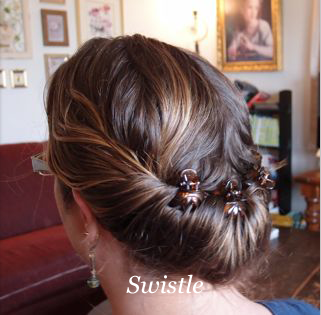
Today I am trying a chignon Gibson Tuck. I didn’t look up how to do it because I thought I remembered how (make a low loose ponytail, then pull the ponytail open right above the elastic and stuff the ponytail into there), but I think I should probably look it up because I didn’t know what to do after THAT. I used little clippies, but it seems like there could be a more elegant method. Also, I wasn’t sure if “stuff the ponytail into there” was the right instruction, or if it would be better to sort of roll it up first or what. Still, overall I like it and will try it again after, like, looking up how to do it [now that I know what it is called].

Screen shot 2013-04-22 at 8.58.31 AM

A Minor and Interesting Ethical Dilemma

Would you be interested in discussing a minor ethical dilemma? My mom and I talked about it for awhile this weekend, and we couldn’t come to any solution that seemed Good and Right. And yet it was a small enough issue that it was only interesting, not upsetting. That is, I am not suffused with doubt and anxiety over this; it’s more that I think it’s the kind of thing that brings up a lot of different interesting issues that could then later be applied to larger situations. My mom said it’s the kind of thing that would be in a book of discussion questions for groups, which is what made me think of doing the post.

Here is what happened: I took four of the kids to see a school play. The cost to get in was $3 per person, maximum $10 per family. As we approached the door (so, no time for thinking things over), one of Rob’s friends said (in a pleasant, charming voice), “Hey, can I be part of your family?” Meaning: Could he come in with our group and not pay his $3.

My assessment: Obviously that’s ethically wrong. But it would be extremely awkward to tell him no. And it’s minor, not major. Also, I’m a slow thinker and can’t figure this out.

I said yes. Then I felt a little conflicted about it, but not conflicted enough to do anything, though if I were I could put $3 in an envelope and mail it anonymously to the theater club, since that would at least patch up the money part. So far I’m not that worried about it, but might do it just because it would be pleasing and would remove the element of someone losing out on this situation.

One issue here is the division of ethical responsibility. Rob’s friend is the one who came up with the plan, and the one who involved someone else in a pressured situation, and the one who benefited from it; I paid the same amount of money either way. If anyone were to reimburse the theater club, it should be him. Which is another element that made it harder to say no: it cost me nothing, so it would have been nothing but ethical prissiness behind the no. But it also brings two more details into this: my role was accomplice (as opposed to primary ethics violator), and also it’s important to note that I don’t have authority over the behavior of the teenager involved.

On the other hand, my mom pointed out that one does not want to behave in front of a teenager (one’s own or another) as if such things are no big deal. But then we also agreed that acting in front of a teenager and his friends as if such things ARE a big deal can backfire. And, frankly, such things probably AREN’T such a big deal: this is probably on par with finding after you get home from the store that the cashier charged you for one $2 plastic plate when you bought two. Except since I was not oblivious in this case, it’s more like noticing that the clerk rang up one plate instead of two, but noticing it when it would be awkward and uncomfortable and some minor hassle to fix it (like, after putting my credit card through) and deciding not to. Or maybe it’s like if the clerk winked and rang up both plates as one. Yes, that’s a little better, because it captures the prissiness of response that would be required to Do The Right Thing, and that I’d be bossing/criticizing someone ELSE’S ethical behavior.

You could probably also factor in that for the same $10 the theater club would have let me bring in two more people: Paul and Henry. This doesn’t factor in directly (i.e., the obvious response is “Yes, but that’s because they’re in your family; this other kid was not”), and yet it does add another detail to consider.


So! Isn’t that kind of interesting? We kept circling back to, “Well, it WAS wrong, and I should have said no”—but then getting to “Yes, but then what would I have SAID? Like, what ACTUAL WORDS?” and the fact that it was not a huge deal and that it wasn’t fully my own ethical decision. Which is why it’s so good for thinking through: I DON’T wish in this case to go back in time to do it differently; even with time to think, I would make the same choice in this particular situation. But there could LATER be another situation where I DID consider it a big deal, and all this thinking-it-through NOW can help counteract my slow on-the-spot thinking.

The Breakfast Club

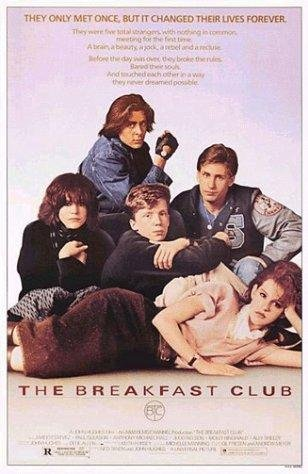
Tonight I am watching The Breakfast Club. Allow me to remind you of the poster:

Screen shot 2013-04-13 at 7.04.53 AM
(photo from IMDB.com)

If this movie was one of the big influences of your teenager / young adult life, I have a question for you: Which boy from that movie was your favorite? I think we’re going to need a poll, though I do hope you’ll go into explanatory detail in the comments. (I was a Judd Nelson girl. The earring.)

[yop_poll id=”2″]

Kindergarten Handwriting

Screen shot 2013-04-12 at 9.38.35 AM

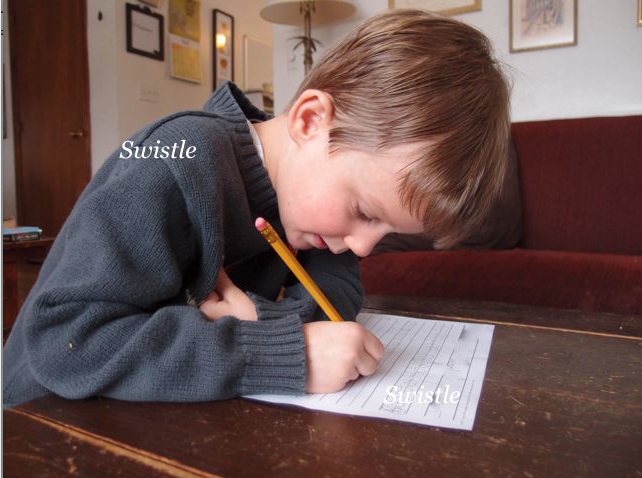
It is good, I guess, to get a periodic reminder that I didn’t do the wrong thing when I switched my major from elementary education to business. I have been VERY FRUSTRATED, because Henry’s teacher has asked me to work with him on his handwriting and I’m finding it…challenging.

I can see that he’s definitely having trouble with his writing: I’m saying, “Okay, now write a lowercase N!,” and he’s making a little hill with no stick, floating in the middle of the dotted-line area it’s supposed to be below. So I say, “No, remember it goes below the dotted line, and it’s a little stick first and THEN the little hill.” Meanwhile I’m thinking it would be super-useful if I knew the terms the TEACHER uses for these things. Maybe part of the issue is that she doesn’t say “little hill” and “little stick” and he has no idea what I’m talking about.

Though it seems like a bigger issue is that he doesn’t seem to have been taught to make his letters yet. I consider it my job to help with homework and reinforce skills (e.g., hold flash cards, practice spelling words, check math problems)—but that’s after the teacher has done her part, which is teaching the skills. If he’s making his O’s from the bottom and he doesn’t know a lowercase N has a little stick and he doesn’t know what the dotted line is for, then I’m not reviewing/reinforcing, I’m TEACHING. I’m not trained or qualified for that, AND IT SHOWS.

Let’s not pretend that “Just go talk to the teacher about it!” is an option here. What’s really going to happen is that I am going to keep working on this with him every day, and then next year he will have another teacher who will either teach him to write or will refer him for special services. He’s only in kindergarten, so I am not particularly worried about it. My main worry is not his writing, but that the teacher will think he’s bad at it because I’m not doing a good job teaching him.

SUFFICIENT UNTO THE DAY

I am having a long, slow, and mild freak-out about moving on to the next stage of life. Perhaps “freak-out” is the wrong word for something slow and mild.

Anyway, I was fretting about my fretting, and kind of SCOLDING myself about it—and then I realized I don’t actually have to do anything about it at all. Fretting about stages/aging is like fretting about breathing, or maybe more like being 30,000 feet up on a non-stop flight and fretting that I don’t really want to go there: it doesn’t matter if I’m mentally on-board or not, because I’m PHYSICALLY ON-BOARD.

I can fret all I like about not being ready or not wanting to go onto the next stage or not knowing what I’ll do when I get there, but it’s not like trying to make myself eat better or exercise more, where if I don’t take action nothing will happen. Assuming the plane doesn’t crash, I WILL continue to get older, and probably WILL start adding “Better than the alternative, har har!” every time I say it. Henry WILL go to first grade next year, and I WILL have a different way of living as a result of it. I WILL have to start paying for teenager car insurance and college educations; I WILL have to deal with the children dating, and bringing new people into the family whether I like them or not, and naming their children whatever they choose, and living wherever they want to live; I WILL have to see my face sliding down. Better than the alternative, har har!

The thing is, as with most other fretful situations, it’s not going to happen ALL AT ONCE, so I don’t need to WORRY about it all at once. When my babies were babies, I had a tendency to pre-freak-out about kindergarten and school bus issues and sleepovers (on one memorable occasion I cried over my 2-week-old baby, imagining him an old man in a neglectful nursing home)—but it worked pretty well to override that as much as possible with a Sufficient Unto the Day Is the Trouble Thereof concept, worrying instead about whether the baby ought to have better neck control by now, and are we almost out of diapers, and is this a tooth or an ear infection. That way, by the time it was actually TIME to worry about sleepovers, I was DONE worrying about diapers and teeth and rolling over and could concentrate JUST on sleepover fretting. No sense doubling up unnecessarily.

So in the same way, it would be silly to fret NOW about what kind of person Rob might marry and what that other person’s family might be like, when I’m already pretty busy worrying about his retainers and his high school course selection sheet. It’s not that thinking “I shouldn’t worry” STOPS me from worrying, but sometimes it lets me redirect the worry to CURRENT concerns.

Where was I? Didn’t I start out talking about aging? Young man, have you seen my purse?

Haircut

I got a haircut, and I told the stylist specifically what I wanted (“To grow it long, but wear it up”), and she said a blunt cut would be best for that. Then I told her that I also sometimes wanted to wear it down, and that I would prefer to have some layers, and that I didn’t mind if that meant having little pieces sproinging out of the updos. I reassured her about that several times: “I know it means little sproingies! I don’t mind! I LIKE little sproingies!” It turned out that I was wrong about that.

I think I was picturing that the sproingy pieces would be softly and charmingly disheveled-looking, but instead they just stick out everywhere in a bristly, non-romantic way, and keep me from making a smooth braid or twist. Luckily my stylist knows I don’t always know my own mind (it’s one of the reasons I am so loyal to her), and so she didn’t put in MUCH layering (just one long layer and some ends-choppiness) and she didn’t do MUCH tapering (just a few pieces). It’ll be easy to grow out.

But then I’ll have all-one-length hair, and it’ll look like a triangle when I wear it down. Dilemma. Well, there’s just no such thing as having hair that is BOTH of the opposite ways I want it, at the same time. This is how mullets came to be.

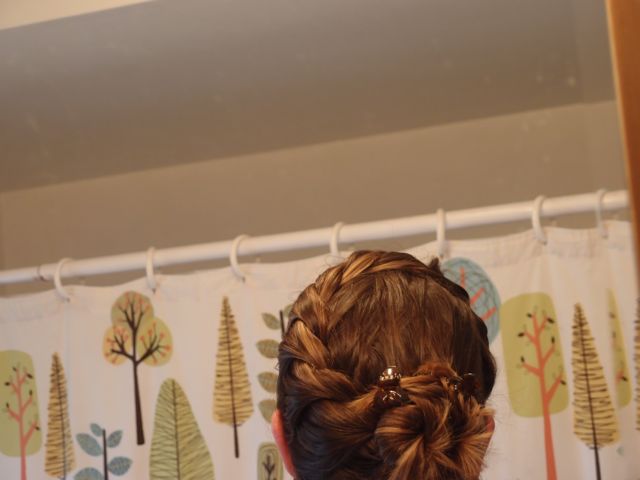
I did something really cool with it today (it would be cooler without the little pieces sticking out) (BYGONES), but then got extremely frustrated trying to get a picture of it.

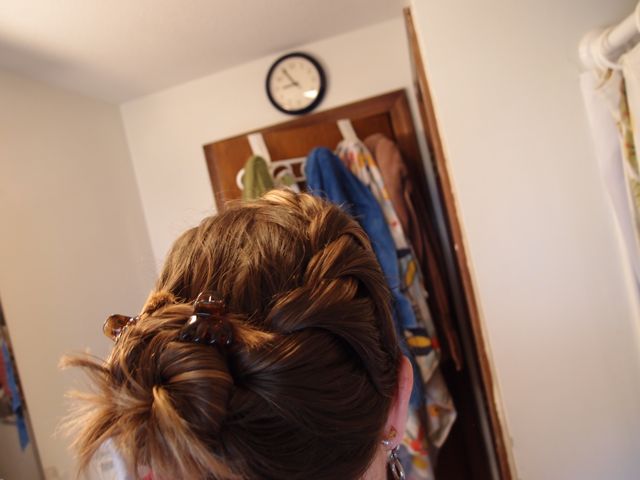
First there were twenty pictures like these first three, as I tried to hold the camera behind my head:

OLYMPUS DIGITAL CAMERA

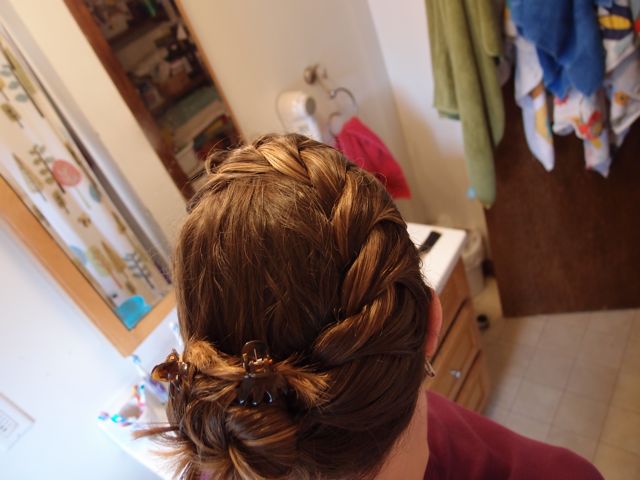
OLYMPUS DIGITAL CAMERA
(You see what I mean about the unromantic sproings?)

OLYMPUS DIGITAL CAMERA


Maybe it would be better to take the picture in the mirror, so I could get farther away?:

OLYMPUS DIGITAL CAMERA
Nope.

OLYMPUS DIGITAL CAMERA
Nope.

OLYMPUS DIGITAL CAMERA
Hope rises! This is getting better!

OLYMPUS DIGITAL CAMERA
Nope.


Okay, just…never mind. I’ll TELL you about it. It’s one of those two-strand twist things, but I started it over one ear, and then did it over the top of my head and around to the back. Then I put the last bits in a bun that ought to look charmingly disheveled but instead looks like a wad of hair-ends. (IT’LL BE EASY TO GROW OUT.)

School Notice; The Road; Hot Cinnamon Schnapps

I often wish we’d get an EARLIER heads-up from school about things that will be needed. The twins’ classes are making bird-nest bags at school, and so we got a note home from the teacher saying each child needs to bring in a net bag (like the kind that has onions or apples in it) by next week, and to please send in extra bags if we have them. If I’d known this, say, a month ago, I could have been saving bags and/or looking for alternative sources for them. As it is, I had to go out and buy two bags of overpriced apples just to harvest the bags.

********

I read The Road, and I was very nervous the whole time because I remembered reading something someone wrote about it that convinced me it was not a good book for me to read even though I like apocalyptic fiction, but I couldn’t remember what it was they said. It was okay, though.

I wouldn’t recommend it, however, mostly because it destroyed the Fun Apocalypse Thoughts I have sometimes, like when I stock up on peanut butter or when I buy a hand-crank radio. Now I realize it wouldn’t matter if I were prepared for a genuine emergency or not, because someone stronger and meaner would come and take everything I had within microseconds.

Also, I was confusing it with On the Road, so I was thinking it was a Famous Old American Classic I Really Ought to Read for Cultural Literacy. But actually it’s from 2006 and it’s an Oprah’s Book Club pick—a category I’ve learned through bitter experience to avoid.

*******

Have you tried DeKuyper’s hot cinnamon schnapps? It has a Swear Word in the name, which I won’t put here since I’m ALREADY getting blocked by some workplaces. I bought it on a whim, and Paul and I tried it, and we both liked it. Paul said it’s like someone took huge handfuls of red hots and melted them into a bottle of vodka, and I was too busy coughing to do more than nod my agreement.

At What Age Can Children Start Staying Home Alone?

Melissa H. left a comment on this post:

At what age can/do children start staying home alone?

In our situation we’re talking about one kid home alone for up to, say, 30 minutes while a parent runs to the store. She is pretty mature for her age and she is pleased with this arrangement (she doesn’t have to run the errand). When I mentioned this to a friend I could tell they were slightly horrified we left her home and they have not left their years older son home at all. Our kid is 7.5–is this too young?


At our house I’m finding a big difference in what age each child Seems Ready. My eldest (age 14) seemed ready when he was quite young, because he’s always been the responsible and cautious type; I’m STILL not entirely confident about my secondborn (age 12) (I do leave him, but I worry more).

I probably base it mostly on my confidence in the child’s ability to use the phone. Do I think they could use it to call 911, or to call my cell phone, or to call their grandparents up the street? Do I think we’ve had enough conversations on the topic that they’d know for what situations to call each number? Do I feel pretty sure they’d know NOT to use the phone if there was a fire, but instead to run next door?

I also base it on how much interest the child has shown in hypotheticals. Three of my kids think it’s fun to talk about things like would they be allowed to use the microwave, and what would they do if someone came to the door, and what would they do if the phone rang, and what would they do if they got a small cut but I was due back in 5 minutes. Two of my kids find such discussions boring, and they tune out if I try to discuss it with them. The two who tune out don’t get left on their own as much—and I prefer to leave them with one of the other three, just in case.

I also base it on how quickly and easily I could get home again. If I’m walking next door to talk to a neighbor, I’m much more likely to leave a responsible child on his or her own than I would be if I were going ten miles away, or if I were going somewhere I might not have phone service, or if I were going somewhere I wouldn’t be able to leave. I can easily abandon a grocery cart, but would reallllllly not feel comfortable leaving in the middle of a hair cut or a doctor or dentist appointment.

And finally, there’s the miscellaneous issues for an individual trip: how many other kids are home and which ones are they (is there likely to be fighting?); whether the kids are playing nicely at the moment or whether they’ve been bugging each other; how much faster/easier it would be for me not to bring them; whether I’m pretty sure my parents are home in case there’s a problem; etc.


How do you make the decision about when a child is old enough to be home on his or her own?

Edited to add: I think when we’re discussing this it would be useful to keep in mind that there’s a big difference between leaving a child at home for half an hour to run an errand, and leaving a child alone for a workday or overnight. I suspect the laws and recommendations are set up mostly to address the latter situation, not the former.

Sleepovers

Life of a Doctor’s Wife left a comment on this post, saying:

I would be interested in more on any of the topics you briefly addressed, but perhaps specially (and… not as… potentially personal) in the topic of first sleepovers. I feel stressed out about the idea of sleepovers and I do not yet have a child. How did you get to be okay with the parents and the overnight situation? How did Elizabeth feel in preparation – anxious, excited, meh? I suppose I am so interested because sleepovers were tough for me as a kid. I did not make it through many of them. (My poor parents. Who lived waaaaaay out of town and had to fetch me at odd hours of the night.)

I was Not Particularly Okay with Elizabeth going to a sleepover, but Elizabeth was so completely Relaxed and Fine about it, it made me wonder if this was one of those “No, in fact DON’T listen to your gut” situations. I mean, my gut was clearly telling me she SHOULD NOT GO—but my gut also tells me the kids shouldn’t get on the bus the first day of first grade, shouldn’t be left at birthday parties even when all the other parents are dropping off, and shouldn’t go up to other children at the park and try to play with them. So my gut is not really calibrated for being in charge of decisions.

In this particular case, I reasoned it out. I don’t KNOW-know the parents, but I recognize the mother enough to say hi if we cross paths. Their house is in the same neighborhood as ours. Another acquaintance of mine babysat for their daughter when she was a baby. The only other sibling is a sister (not, for example, a much older brother), and one of my older kids is in her same grade and knows who she is and has been on the same bus with her for years. I found out from Elizabeth who else was invited and what the plans were, and it sounded well-organized and well-thought-out (four girls total; plans to make cupcakes and watch a Pixar movie and stay up until TEN!! O’CLOCK!!).

Fine, I also went on Facebook and snooped the family. I looked through photos and saw pictures of the family at Disney, at what looked like a big family event, and in Christmas-card photos. I looked through wall posts and saw things like “Hey, great talking you the other day! Let’s have coffee next week! Thursday?” and “Sophia left her sweater at our house—I’ll send it to school with Ella tomorrow!” It’s not like non-okay families couldn’t have these photos and wall posts, I realize. Nevertheless, it added to my decision-making process.

I’ve heard of other parents deciding to allow things like sleepovers (or even playdates and birthday parties) only when they know the other family well—but I have almost zero social life, so that’s not going to work for me: I hardly know ANY other families well. If that were the cut-off, then my social life would have an inappropriately heavy and limiting impact on my kids’ social lives. (Or else theirs would have an inappropriately heavy impact on mine, when I was forced to form a large fake social circle to accommodate their friendships.) But this would be a great tip for people who know a lot of other families: I can picture being ENORMOUSLY reassured if Elizabeth were sleeping over at my friend Melissa’s house, instead of at the house of someone I only know to say hi to.

I also talked myself through it like this: Elizabeth is more social than I am, but at this stage she needs my help to arrange the logistics of her social life—and I have to try not to let my own social anxieties get in her way unnecessarily. I can of course say no to anything that seems genuinely dicey to me, but most situations are NOT genuinely dicey even if they make me nervous. If three other moms feel it’s appropriate to have a sleepover party at age 8, and if Elizabeth herself is fine with the idea, then I can either decide that she’s not ready and/or that I don’t want her to go—or I can let her try it, which is what I decided to do.

And it went great. I talked with her ahead of time about how to handle things if she wanted to go home early, even if it was the middle of the night. I also remembered that one of my own biggest issues as a child was not realizing that the other child’s parents were PARENTS and were therefore likely to be pretty easy to talk to if I had any situations (like if I forgot to bring something, or if I wasn’t sure if I was allowed to do something, or if I couldn’t find something), so I told a few anecdotes along those lines to Elizabeth. But she stayed the whole night and didn’t run into any issues except for forgetting to bring a comb, which she just did without.

Oh, and one more thing: I deal with stress via shopping, so I spent a lot of time looking for a good party gift, and I window-shopped for many possible purchases such as a sleeping bag, new pajamas, and so on. I think I must think things over while doing things like that, so that by the time I’m done filling an online cart with sleeping bags and pajamas I never end up buying, I’ve adjusted to the idea of a sleepover.

How to Handle It When One Kid Isn’t Doing as Well in School as Another

Here I am, back for more immersion therapy. Leeann asked a question on yesterday’s post:

So, I have a topic that I’d love you to bring up on your blog because I am curious about how other people handle it.

I have three kids. Two are total meant-for-school students- they sit and listen, have great memorization skills, work hard-ish etc. They just do really well at the whole “going to school thing.” My third child, however, is not a meant-for-school kid. He is super smart but to sit and listen, to do redundant worksheets etc is NOT his thing. He works hard-ish but his hard-ish gets him low Bs and Cs (in advanced classes) while the other two get straight A’s. I’m never quite sure what to do when report cards come around. One is clearly not like the others. I don’t want to take away from the first two by minimizing their awesome grades but I don’t want to make child 3 feel inferior for his grades when I know his effort was there, it just that school doesn’t measure his particular strengths like it does theirs. Does anyone have any help for me in this issue? We do talk about making efforts and individual strengths etc but it feels a bit forced to my ears.

I’ve run into this, too. I’m finding it especially difficult with the twins, because they’re in the same grade and getting tested on the same things, so the comparisons are pretty obvious and exact. All of last year, they had the same spelling list, and Elizabeth was getting a much higher grade every single week than Edward; I didn’t want to praise her in a way that made him feel bad, but I also didn’t want to NOT praise her.

So far I’ve been doing a mix and match of these things with all the kids:

1) Emphasizing individual strengths, as you’ve been doing, whenever it comes up. We do a lot of frank  “Well, Elizabeth might just be better at you than spelling; you both spent the same amount of time studying, so it might be that it just comes more naturally to her. Other things come more naturally to you. [Giving example or not, depending on whether one comes readily to mind and/or exists.]”

2) Praising privately. I’ll wait until Edward isn’t around and then say, “Wow, Elizabeth, you did GREAT on your spelling test!” Sometimes I’ll mention to the praised child that I’m not making a big deal about it in front of another child, and I’ll re-emphasize the “People have different strengths” along with the “We don’t brag and make other people feel bad, especially if our strengths are inborn as opposed to coming from hard work.” Then I can also praise Edward separately, saying things like, “You did really well on your spelling test this week!” (if he did, for him), without Elizabeth pointing out that it’s not good compared to HERS.

3. Praising everyone publicly at times when things are more even. “Wow, Elizabeth, look at your spelling test this week! And Edward, good job getting your orange belt! William, this is a great painting!”

4. Finding other things for the doing-less-well child to thrive at. This one’s not always an option. But if the not-as-academic child could do really well at, say, karate, it gives another way to make accomplishments feel more balanced.

5. Just not discussing it much. It does feel bad to minimize someone’s academic accomplishments just because a sibling is getting lower grades—but on the other hand, there have been a lot of mixed reports recently on how abundant praise affects children. Looking at all three report cards and then saying an enthusiastic “Nice job, you guys!” (with no sharing around of grades) might make everyone feel happy. (And this can be combined with #2, speaking privately later to each of the two who got great grades, as if just bringing it up again as you would with any of them: “I just keep thinking of that great report card you got!”)

6. Additional private discussions with the child who gets lower grades can also help: saying that you know the child tries as hard (or harder) for less result, and that his effort is as important to you than the specific letter grade might help considerably. Rob has a lot of trouble with writing, and on his most recent report card he got a non-excellent grade in language arts—but accompanied by a note from the teacher that he was trying hard. I told him that was my favorite part of his report card—and it really WAS. (I’m not sure this method would work if it weren’t true.)

7. Sometimes it’s better to get A’s and B’s in regular classes than C’s in advanced classes. I’ve felt like there’s a lot of pressure from our school system to put kids in the highest possible level their test scores indicate they can handle—but as you’ve noted, some kids are just as smart but don’t do as well with the sitting down and worksheets type of learning. My plan is to whenever possible put kids in the classes where their grades reflect their effort. If that means letting them go down a level, I’m willing to do that. The GPA can even end up being exactly the same (I don’t know if all schools divide things the same, but at our school a C+ in honors/advanced class is the same GPA as a B- in an A-level class—but the B would feel a lot better, and be more comparable to his siblings’ grades).

********

How do you handle it with your kids?