(image from Amazon.com)
The Husband’s Secret, by Liane Moriarty. I started this book, but gave up just as I started the second chapter. The gimmicks INSTANTLY bothered me: drawn-out mystery, switching storylines at a cliff-hanger, starting a new storyline in a way that deliberately makes the reader wait a page or two to know what on earth is going on. Plus, there was lots of irritating exposition: we’re reading about a woman wondering whether or not she should open the “in case of my death” letter she found written by her husband (who is not dead but is on a business trip), but the author is using the scene to explain to us in a distracting, noticeable way what the main character and her life are like. Why not go all the way and have her look in a mirror in order to describe her hair and eyes?
But then my mom read it, and she said I should give it another chance. She assured me that the drawn-out mystery was worthwhile (I’d have placed a money bet that it would be drama for the sake of drama, followed by a disappointing reveal) and not overly drawn-out, and that the book hit its stride pretty soon. And I DID give it another try, and I DID like it. Very much! Very, VERY much! So!
I did strongly object to the amazing number of times a size-18 woman was referred to as “morbidly obese” and considered wayyyyy too fat for anyone to ever be interested in her—the kind of fat where she’d walk into a room and people would stare and whisper and giggle. It made me think of those web sites where people send photos of what “size 18” or “200 pounds” actually looks like at various heights and on various body types, to counteract the weird impressions society has about what the numbers look like.
It’s a Maeve-Binchy-like book, in that there are several interlocking storylines. When I was describing the book to someone else, it sounded soap-opera-y (hardly anyone in real life has SO VERY MANY dramatic things happen to them), but it didn’t seem that way when I was reading it. Instead I came away with a fresh dose of that slightly jaw-dropped understanding that these dramatic things really do happen to real people.
There are several Quite Sad scenes involving children and parental grief. I found I was able to bear it, but it was a close call and I did some skimming. There were a lot of scenes where a character was thinking in a way I recognized, which gave me that happy bonding feeling you get when someone’s thought processes are very similar to your own. Things are tied up nicely at the end (not entirely, but enough), and there’s some Omniscient Narrator stuff of the sort I enjoy. I was always very eager to get back to the book, and I thought about it a lot when I was reading it and also afterward.
(image from Amazon.com)
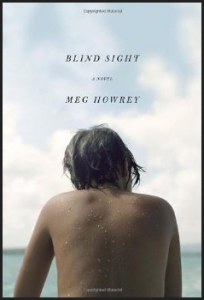
I would have said I didn’t want to read EVEN ONE MORE coming-of-age novel about a teenaged boy, but I was wrong. (I think what I actually want is to never hear another novel about a teenager referred to as a coming-of-age novel.) I added Blind Sight, by Meg Howrey to my library list on Meredith‘s recommendation, and I loved it so much I’m reluctant to recommend it, because what if you don’t like it? Also because it’s a teenaged-boy coming-of-age novel so there are a lot of embarrassing sexual references in it.
I generally don’t like books written as letters or as essays or whatever, but I thought this one pulled it off (and it’s only PART essays). When I was reading the first page or two I thought, “Hmmmm….I don’t think I’m going to like this…” but I very quickly changed my mind. I thought it ended up working great, in fact: a way to see the main character as he saw himself in addition to how the author described him.
I liked the basic story (teenaged boy meets father for the first time), but what I MOSTLY liked were the boy’s thoughts and observations and the way he expressed them, and the way the characters acted and talked. I kept saying to Paul, “I can’t believe how much I like this. This is just exactly my kind of book.”
At the end, I was disappointed to be left hanging on an issue or two. I wanted MORE. I think there needs to be a sequel.