Swistle’s First Protest

Have you seen that picture of a guy at a protest holding up a sign that says “Not usually a sign guy but geez”? That is basically my position. I’ve never been to a protest, not because I haven’t objected to things before but because protests and signs and chanting have not been my thing.

But geez.

We are deciding right now, as a country, whether we’re going to shut people out of our country (including people begging for our help escaping an enemy we share) based on race and religion. That idea fills me with cold horror. So I vote no. And to be more precise, I vote HELL NO. And when what you want to say is “HELL NO,” a protest is a good place to say it.

Here were my anxieties, before the protest:

1. What if there’s not enough parking at the subway station.
2. I don’t know how to use the subway.
2a. I don’t know how to buy a ticket.
2b. I don’t know how to tell what direction the train is going.
2c. I don’t know how to switch lines, or if I need another ticket for that.
2d. I don’t know where to get off the train, or what to do after that.
3. The whole finding-a-place-to-pee situation.
4. I hate cities.
5. I have trouble with maps. How do I find where the protest is?
6. Should I make a sign? What should it say? I feel self-conscious.
7. What if I hate the feel of being in a big crowd?
8. What if things get violent?
9. What if we all run at once and people are getting trampled?
10. Do I have to worry about other people knowing I’m there?
11. Do I really have to leave my phone at home? But what if I need it?
12. Will there be repercussions for this, for me or my family?
13. What if no one else shows up?
14. GOING TO A PROTEST AT ALL, THE WHOLE THING

I think it helped that it happened fast. I debated about the women’s march for weeks, and eventually talked myself out of it. Afterward, I wished I’d been a part of it. This time I had less time to think, and also I could remind myself of my previous feelings of regret.

Also, Rob and William said they wanted to go with me. This increased both my anxieties and my interest in going. It added these anxieties:

15. What if they get hurt?
16. What if there are repercussions for them—colleges, jobs, etc.?
17. What if we get separated in the crowds?
18. Wait, but now we REALLY NEED our phones.
19. I don’t really know what I’m getting them into, and one of them is a minor.

Well. But we went. We did bring our phones. We turned off location and turned off the phones and we password-protected the lockscreens; according to protesting tips lists that may not have been enough, but that is what we did.

We made a flappy uncertain effort at signs, using half-size posters we keep on hand for school projects. I felt self-conscious about what I wanted to write in large letters and then hold near my face, and spent a fretful half-hour looking through pictures of other protests for things I felt reflected my thoughts on the topic. We ended up with signs that fell well within range: ours weren’t as funny or creative or clever as a lot of the signs we saw, but there were people there with signs written on the torn-off upper half of a pizza box, so.

I wanted a sign without a stick, and on flexible paper I could roll up, to make it easier to bring on the subway. But TONS of people on the subway had rigid signs with sticks, and that worked just fine, and that kind of sign is WAY easier to use AT the protest. We made a note: next time we will favor rigid signs with sticks. [Note: I have since learned that you shouldn’t use a rigid stick, because it can be interpreted by the police as “a weapon.” A wrapping paper tube works well as a “stick.”]

I’m sorry, yes, that was two paragraphs just about making the signs. Those of us who’ve been in the “not really a sign girl” category have a bit of a learning curve to deal with.

We did find parking at the train station. On a weekday that station can easily reach capacity, but it was a weekend. It was surprisingly full for a weekend, but there were spaces. We found an ATM-like machine that said it sold tickets, and I managed to figure out how to buy some. I bought adult tickets for Rob and William when probably they could have had student tickets, but I was in no frame of mind to figure out the details. I noticed that at other machines, people were asking other people how to work the machine; this gave me a happy feeling that I could have help if I needed it. No one seemed to be impatient. When I went to another city on a weekday once, the people behind us in line were reaching around and saying, “SIGH, no, like THIS,” which is helpful in its own way but also a little flustering.

There were bathrooms at the subway and we thought we’d better take any chance. In line, a girl started talking to me in a friendly way: “Not as busy as last week!” (she meant the women’s march, I assumed). And I said I hadn’t been there last week but I’d heard it was amazing, and she said “SO AMAZING. But this is looking good too!”

I joined Rob and William in the hall outside the bathrooms, and I suggested my plan: ditch the three pages of subway maps and directions, and do this by the “follow other people who have signs” method. Rob was not a fan of this plan. I persevered, and I was correct: it made the whole thing easy. We knew already which train to get onto at the start, but if we hadn’t known, we could have followed. Then we followed people off that train and onto a different line (i.e., a different train route), and then we followed them when they got off at a stop, and then we followed them down a couple of city blocks, and then we arrived with them at the protest.

I don’t know how many people were there, but “lots.” There were helicopters flying overhead, and I saw overhead photos later and it looks like just hella lots of people. I was glad to find that big crowds don’t freak me out—but if things HAD felt too close, it would have been easy to get more on the outside of the group for more air: most people were trying to get further IN.

We weren’t close enough to be able to hear the main speakers, even though they were REALLY YELLING into a microphone. (The protest was larger than expected, and we were kind of around a corner.) So that was a little boring, to stand there listening to what we couldn’t hear. Periodically the speaker would, apparently, start a familiar chant, and then the crowd would join in. Some of the chants made me feel self-conscious: I am not naturally inclined to yell things that start with “Hey hey! Ho ho!” and then add a rhyming line. But okay, fine, I did some of it. And I liked other chants better. There was one with a very catchy rhythm, almost song-like, where a few really loud people in the crowd would yell “SHOW ME WHAT DEMOCRACY LOOKS LIKE!” and the whole crowd would yell back “THIS IS WHAT DEMOCRACY LOOKS LIKE!” and I kept getting choked up. …It’s a lot better when you can hear it. I’ll bet they sing-chant it at all the protests now, so you can hear it if you go.

It felt good to be in a big crowd of people who felt the way I did about the situation. That is just always going to feel nice.

It was fun to see all the signs: there were a lot of good/funny/clever ones.

I’d wondered how we’d know it was over, and whether there’d be a mad dash for the trains. The way we knew it was over was that someone with a really loud voice said “Thank you all for coming, be safe!” and there was some cheering and then we all started walking back to the train. Probably there were some people walking briskly to get there ahead of others, but I didn’t have that impression of the crowd as a whole: casual strolling, lots of chatting. We were able to get onto the first train that arrived after we did, though it ended up being crammed full—but the subway had arranged extra trains, so there was another one coming along in 2 minutes and another one coming 2 minutes after that. It felt as if everyone (police, subway) was VERY familiar with how to deal with the extra crowds, no big deal, all in a day’s work.

I would have been more nervous about the packed-full trains (we are STANDING UP on a moving vehicle and all crammed together with strangers), but everyone else was so yawningly chill about it (reading paperback while swaying, or chatting with someone else, or literally yawning while looking out the window) and that calmed me. Also, in both directions I was right next to someone holding a sweet, calm, well-behaved little dog in their arms, and in both cases the owner said it was okay to pet the dog’s soft little ears, so in both cases I did. A calm soft dog ear is even better than a worry stone.

I was glad I’d gone. And I felt so much better getting the first one done: for me the worst part is not knowing how things will go and not knowing how to handle all the logistics. Even if the next protest I go to is in a completely different location, I’ve still learned a lot of the basics and will be much less nervous next time. And when you are in a very low-power situation, it is nice to be able to say you DID do some of the things you COULD do.
Appetizer Recipes for People on Diets

Oh, hello! Let us say you are going to a wine-and-appetizers get-together with friends, but it is January and so some of you are eating less cheese dip and brownies than usual. And let’s say you would like to bring something that is not too depressing, but also that people CAN eat. Someone else is already bringing fruits and vegetables. My only idea so far is a bag of Smartfood Delight popcorn (35 calories a cup), so the comments section can only go up from here.

Round Robin

Are you familiar with the concept of “round robin” letters? I have no idea if this is the sort of thing where everyone knows it duh, or not. Wikipedia, I notice, says that round robin letters are Christmas newsletters; I don’t think that is true, though perhaps it’s another usage of the term. I could have clicked the citations but I am eager to get back to The Good Wife: I just finished the first season and that is a cliff-hanger I would like to get back to.

This is how a round robin works. Let’s say you have a friend group of four, and Friend A starts it: she writes a letter, and she mails it to Friend B. Friend B reads the letter, writes his own letter, puts both letters in an envelope and mails them to Friend C. Friends C and D do the same, and Friend D mails the whole packet back to Friend A, so that Friend A receives an envelope containing four letters: her own plus three more. Friend A reads the three new letters, then takes her own letter out and writes a new one and puts it in, then mails the packet on to Friend B. And ’round and ’round it goes: after the initial start-up, where it is just one letter and then just two letters and so on, the envelope will always have four letters in it.

Everyone can also put in photos, or newspaper articles, or recipes, or whatever, and each person just takes their own stuff back as it comes back around to them. (This system requires participants who will not lose things, and who will not put a letter in a pile of mail and not get around to it for months.)

Anyway. I just mention this concept in case it could be useful at some point. One of the things I like about it is that in order for one to start, it isn’t necessary for EVERYONE to have EVERYONE’S addresses: if one person sends to one address they know, and THAT person sends to one address THEY know, you can build a circle pretty quickly. It works even better if some people in the circle have access to photocopiers, and/or can be the hub of several circles.

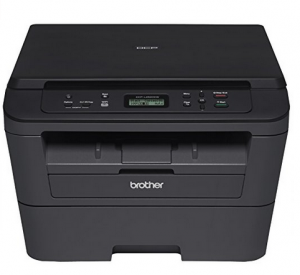
Oh! That reminds me. Our old and much-loved printer finally went into well-deserved retirement, and we had to replace it. The old printer was a Brother brand printer, and so we got another Brother. This one:

(image from Amazon.com)

Brother DCPL2520DW Wireless Compact Multifunction Laser Printer and Copier [edit: it also scans]. It is excellent. We print to it from four desktop computers and two laptops. I do not know how that magic works; I have my own personal IT guy who takes care of that. But one of the things I like best about it is that it’s ALSO a regular old photocopier: you lift the top, put your piece of paper in, and press a button. It’ll even do double-sided copies. This is the ink we buy for it: one-pack or two-pack.

I don’t have many basic throwback life skills, as we’ve discussed. But if the need arises I can put out a double-sided newsletter, yo.

Republic

My social-media input is so divided right now. It’s hard to triage all of it, isn’t it? It’s hard.

I’m overwhelmed, and one set of people in my life is saying “IT’S BECAUSE THE WORLD IS ON FIRE AND WE’RE ALL GOING DOWN IN FASCIST FLAMES UNLESS WE TAKE STRONG ACTION RIGHT NOW!!!!” and the other set is saying “For GOD’S sake, this happens every four years, RELAX already!!” And I absolutely know which side I believe, and I am absolutely at a loss to explain it to the other side. I have voted in a number of elections, and sometimes my choice of candidate has won and sometimes my choice has lost, and I have always felt it does not deeply matter one way or the other, and yet this time I believe it deeply does.

It is different. It is hard to say why it’s different, to people who don’t think it is different. My mother has reminded me more than once how other people freaked out when Barack Obama was elected. How to explain the difference in type and cause of freak-out? How to explain why this isn’t exactly the same way someone else felt when Obama was elected, with the expectation of exactly the same “and everything was fine” results? I remember people saying society would fall apart if Obama won; how is that different from my fears now? How to explain the whole thing to someone in my Facebook newsfeed who says that protesting an assault on democracy is the same as making an assault on democracy, and that everyone needs to get over it / give him a chance? How to explain to someone that NO, it’s YOUR news that’s fake news—when they think MY news is fake news? How to explain that the two things are not equivalent, even though it feels like they are? How to explain it to people who think there is no problem here and that the new president hasn’t even done anything yet?

Well. I don’t know and neither do you, or else it would all be explained and everything would be fine. But in the meantime, I’m panicking and directionless. Thank you to those of you who sent me links to places giving direction, but for some reason I find those make me panic even more. It reminds me of when I heard that we can go right ahead and recycle that piece of paper, and we SHOULD, but in the meantime a business just dumped 10,000 pounds of paper in the trash: we like to say individuals make a difference, but for most of us that isn’t true. We get an electric car to reduce our carbon footprint, and a business adds to the air the exhaust of a hundred thousand gasoline engines every day. Certain individuals, certain organizations: those will make the impact here. The rest of us have to wait and see what they will choose to do, and add our individual pieces of paper to make our own proportionately tiny difference, in the hopes that all together our tiny inputs will add up to one impactful action—and in the meantime, those tiny inputs will make us feel better, by making us feel as if we’re helping. That’s basically what a republic is and does: we all do our tiny part, to give others the power to make big decisions for us.

Today I’m going to Target. I’m taking a Maeve Binchy book with me, and after I shop I’m going to go out to lunch and read my book. When I come home I’m going to write a letter to one of my senators, even though I don’t think it makes a difference, despite people saying it does. I’m going to fold laundry while listening to The 451 podcast. For the time being I am not going to research any more “Ways You Can Help!” organizations: I have set up the monthly payments to the ACLU and a couple others who have more impact than an individual, and I am going to hope that the people who are in charge of preventing the loss of our republic will do so.

Hard Day

This was a hard day. 1) Before leaving for Edward’s colonoscopy, I snapped at Henry and said mean things. 2) Then, on the way to the colonoscopy, I missed a turn in a big city, and ended up in a tunnel that took us somewhere else. 3) Then, Edward’s colonoscopy showed almost for sure that his medication is not adequately treating his Crohn’s Disease. 4) Also, during his colonoscopy we changed presidents.

But it wasn’t all bad. 1) I apologized to Henry when I got home, and I think I can handle things better next time. 2) The GPS helped me find my way back to the right route, and I’d allowed 45 minutes’ padding because I hate city driving, so we still arrived on time. 3) Edward’s GI doctor has a plan (biopsy results, then MRI, then we talk again), and seems chill about moving on to another medication. 4)

Fraught Week

A week with an appointment at a children’s hospital is always a bit FRAUGHT (Edward is having a colonoscopy to check on the status of his Crohn’s Disease; we’ve been through this before, but the prep is still unpleasant, and it is still stressful to deal with the procedure / the city driving / having a child put under anesthesia / etc. ), but also it is scheduled for the same day as the presidential inauguration. So you can guess my mood. And by “mood” I mean blood alcohol content.

Also this week, I took Rob to the first medical appointment he’s had since turning 18, and it was all different: they gave HIM the permission forms to sign, and they had him sign his own HIPAA. After the appointment, he’s the one who received an email with the link to his online patient profile. And his new prescription isn’t in my online pharmacy account, BECAUSE HE IS A LEGAL ADULT AND SO HAS BEEN AUTOMATICALLY REMOVED FROM MY ACCOUNT. It is all very odd, considering he still lives at home and I’m paying all his medical expenses and picking up his prescriptions and telling him to unload the dishwasher and so on.

Also this week, there was an envelope in the mail confirming Rob’s draft registration. He can now be drafted into the military. The draft has always seemed nutty to me, but looking at my 18-year-old child it seems nutty beyond imagination. (“Nutty” is the best word I could come up with here without going off the rails, and I am not happy with the lighthearted whimsy of it, but the more-accurate words seemed to trigger multiple-paragraph rantings.) And did you know that boy children aren’t eligible for college financial aid unless they have registered to allow their government to decide whether or not they have to go fight in a war and kill people and maybe be killed? Well. The upside is that the next war will likely be nuclear, so there will not be time or need for a draft.

I will feel a countdown timer in my head from now until he turns 26 and is no longer on the draft list. I have added it to the list of Special Birthdays, alongside Kindergarten 5, Double Digits 10, and Sweet 16.

Vote on the Movie 2001: A Space Odyssey

On New Year’s Eve we watched 2001: A Space Odyssey. It was my third time seeing it, and it was even worse than I’d remembered. The background sounds were nearly intolerable. It needed Stephen-King-novel levels of editing/chopping. And the major plot elements seemed divided into two types:

1. Super, super obvious insights that were presented as if they were profound. Like when someone is on drugs and starts saying things that seem MIND-BLOWING but are…not. Even if accompanied by a banging drum and a discordant choir.

2. Stuff where someone involved in the making of the movie confused “things that do not make sense” with “things that are very, very deep and profound”—either because he/she personally confuses those things, or because he/she thought the VIEWER would confuse those things and find the result impressive. Like when someone is writing or reading poetry, and thinks that the more baffling/random it is, the more meaningful/deep/profound it is.


Anyway. That was my individual opinion of the movie. I found it just about intolerable, and I never want to see it again OR be in the house while others are watching it.

In expressing this view to the people I live with, I found that Elizabeth could not have agreed more. She did not see why this was the sort of movie her father felt she HAD to see, when it was clearly annoying, boring, and faux-deep. The male persons in my household, however, wanted to argue with me. What EXACTLY did I think was, quote, SO OBVIOUS, endquote? How did I KNOW that some inexplicable parts WEREN’T actually profound? They wanted me to prove to them the unproveable (i.e., that something does not make sense), starting from first principles. Hm, what a tempting offer, but no thank you. I mean, if you say “And also, so-and-so was a terrible actor,” and someone replies, “He was SUPPOSED to be a terrible actor! That was the POINT!,” then what more can the two of you say to one another to achieve peaceful understanding?

Since New Year’s Eve, I have mentioned this movie several times in mixed groups. In EVERY CASE SO FAR, the female people in the group have been of basically my point of view, and the male people in the group have been more aligned with the male people in my household. People have been placed variously on the spectrum, of course, and have had various intensities of feelings. But IN GENERAL, and even with this extremely small sample size, I have seen enough to make me want to do a poll.

Update: So, this is frustrating, but I can’t make the poll work. It wouldn’t format correctly. It insisted that people log in as a WordPress user, even though I unchecked that box when setting up the poll; each time I returned to the poll settings, that box was re-checked. The poll was a nice width on my main page, but if you clicked through to the address of the post itself, it was about one word wide so you couldn’t even tell what you were voting for.

I’m very discouraged. All I can think of is having free-form voting in the comments section, but that’s nowhere near as helpful: we can get 800 votes in a poll when we’d get 25 comments, because it’s way way easier and more fun to vote than to comment. Also, doing it in the comments section is going to make everyone more likely to argue: it’s less provoking to see the numbers and percentages than to see someone saying an opinion in their own words. Also, there are people who cruise around the internet looking to fight about their pet topic: if I get 50% comments in the comments section saying “YOU DON’T KNOW WHAT YOU’RE TALKING ABOUT, IT’S THE BEST MOVIE EVER, YOU’RE JUST TOO STUPID TO UNDERSTAND ITS BRILLIANCE,” but the poll shows only 1% of voters say they liked the movie, it’s a good indicator I have stumbled upon one of those topics. If all I have is the 50% comments section with no 1% poll, I’m going to get discouraged about humanity.

Cleaning Out My Sock and Underwear Drawer

I don’t know how you can guard your heart against a title like that one.

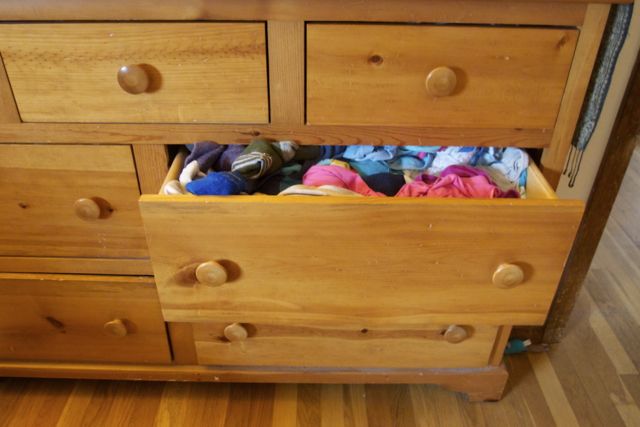
Today’s task: finish listening to last week’s The 451 podcast while cleaning out a drawer that no longer closed: my sock and underwear drawer. Here it is at the beginning of this project, and I am sorry to say I had to look HARD at the before and after pictures to tell which one was which, so visually-speaking this is not going to be one of those giant catharsis projects:

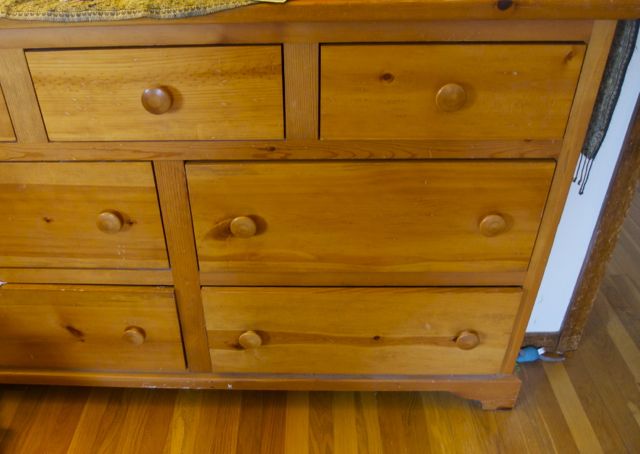
My socks and underwear used to fit easily in two of the smaller drawers above. Let’s not waste time discussing WHO should have fewer socks/underwear, let’s just say that as I began this project, the much larger drawer I had moved them into could no longer open or close beyond what you see there, unless it was getting toward Laundry Day.

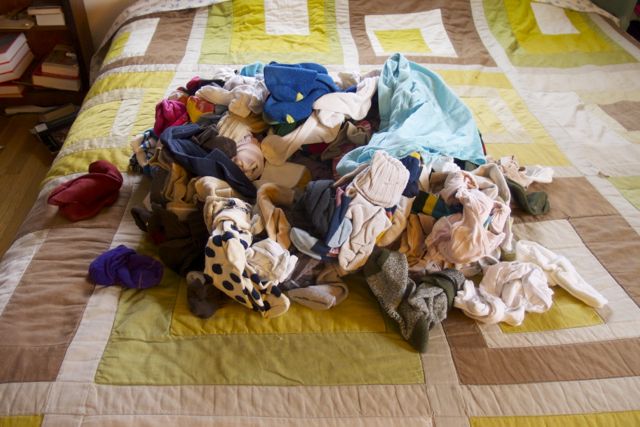
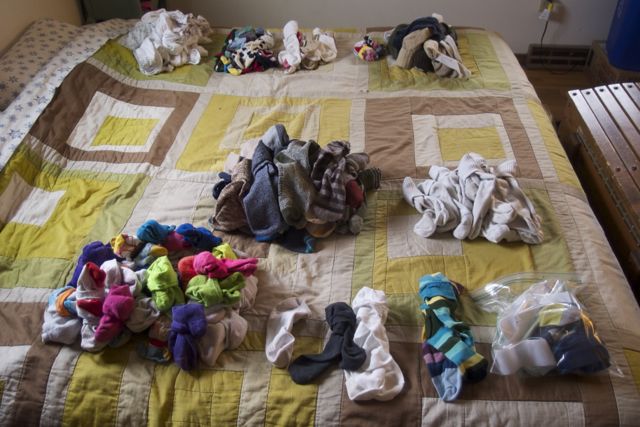
I took out the drawer and dumped everything out on the bed:

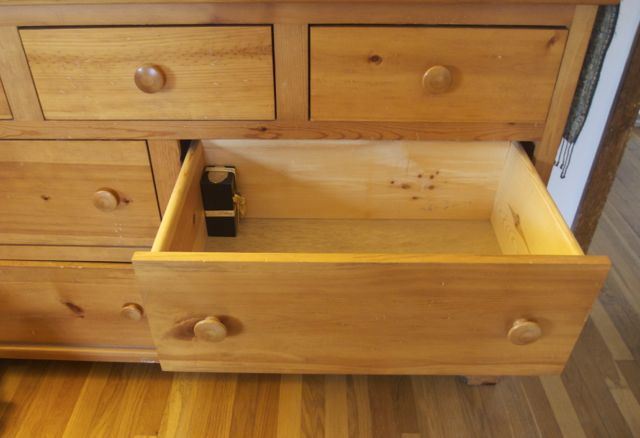
This left a nearly-empty drawer, containing only a back-up bottle of perfume I bought when it was discontinued (L’Artisan Tea for Two):

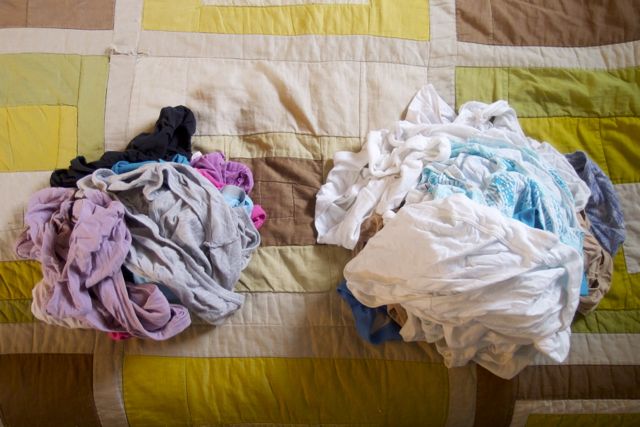
Here is the underwear sorted into “pairs I will wear” (left) and “pairs I hate” (right):

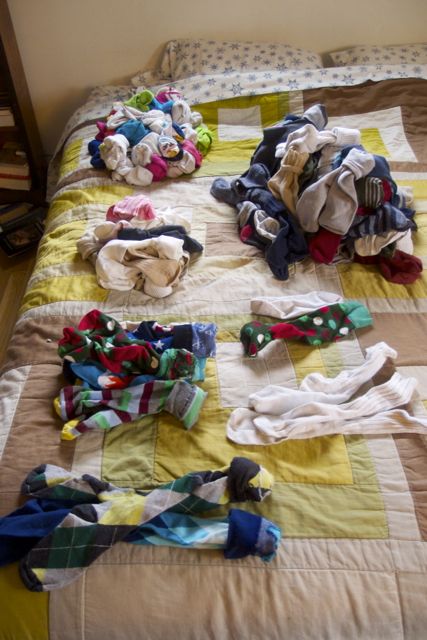
Here are the socks sorted into seven piles. Starting at the top left and going down the left hand side, it’s ankle socks, trouser/dressy socks, novelty socks, and knee socks. Starting at the top right and going down the right hand side, it’s crew/boot socks, singleton socks I needed to think about, and singleton socks that could go right into the trash :


I should not have shifted the point of view so often in this series, nor should I have put the underwear I like back in the drawer before taking this picture, nor should I have put the things I got rid of further away so that they looked smaller—but I did do all those things, so here we are. Farthest from the viewer are the things I got rid of: the underwear I hate, almost all of the novelty socks I like but never wear, almost all of the trouser/dressy socks, two pairs of ankle socks I don’t like, and the crew/boot socks I don’t like or don’t wear. Nearer the viewer is the unfortunately-still-large quantity of things I’m keeping; the largest piles are ankle socks, crew/boot socks, and white crew socks. Then some little piles: three pairs of trouser/dressy socks for the rare occasions I need them; two pairs of novelty socks for the rare occasions I wear them; and I put the two pairs of knee socks in a big plastic baggie with the ankle brace I wear them with, and put that back in the bathroom closet.

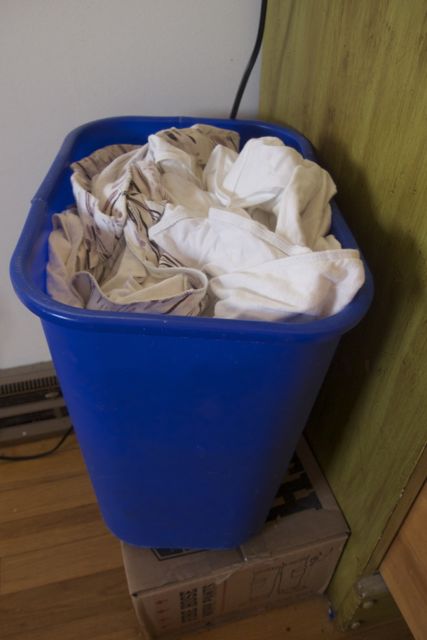
Here is the trash can, afterward, though it was half-full when I started this project:

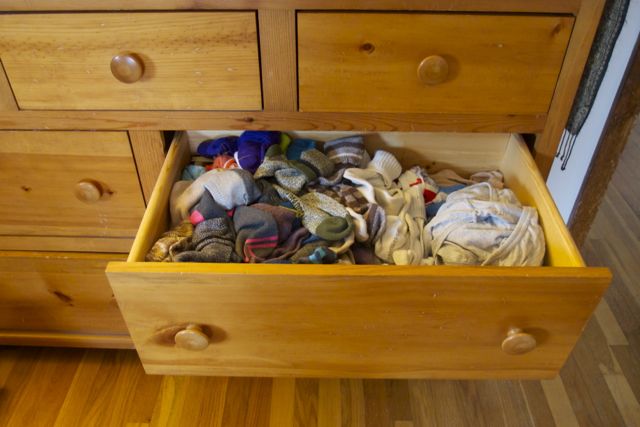
Here is the drawer, afterward, and brace yourself for a disappointing picture of a still-quite-full drawer:

I do wish I could TELL that I had half-filled a trash can. But look, it closes:

And even though it doesn’t LOOK a lot emptier, I can now rummage around in there, which I could not do before. And sometimes I need to do a first pass before I can get rid of more stuff. It would also help if I would rotate my clothes seasonally: I wear the ankle socks in warm weather and the crew/boot socks in cold weather. But I do not rotate my clothes seasonally, so.

Where Do the Kids Do Their Homework?

Hi Swistle!

I’ve been reading you sort of obsessively for many years, have five kids (including surprise boy/girl twins!), and finally have a question I don’t think you’ve addressed yet in the blog:

Where do your upper-elementary, middle- and high-school kids do their homework? We’re a year or so away from needing to use real beds for the toddler twins (our youngest), and when we do that we’ll reconfigure the two shared bedrooms to make them single-sex. We’ve been mulling a loft bed with a desk underneath for our first-grader, but if having five babies in five years taught me anything, it’s that the purchases that seem *so* useful at point of sale are often the ones we’re reselling on Craigslist three years later because…well, by then, everything has changed.

So do your kids have designated workspaces? Personal or shared desks? Are they in their bedrooms, or elsewhere? Do any of them work on their beds or at the kitchen table? I went to high school in the era of AOL dial-up and beige desktops, but while I used my computer a fair amount, I never sat at the desk for anything I didn’t have to type.

Of course, by the time my oldest (now in second grade) goes to high school, they might be stepping into algebraic equations via hologram, but I like doing the research regardless. Thanks for any and all insights.


Oh, this IS an interesting question!

My original plan, back before any of the kids were doing homework, was to have desks in the rooms. That’s what I had when I was growing up. Though, did I use my homework desk for homework? Heck, no: I used it to hold my frosty eye shadows, my frosty lipsticks, my curling iron, my assortment of hair sprays, and my Charlie and Chantilly perfumes. To do my homework, I sat on my bed. But I still had it in my mind that bedrooms should have homework desks.

Then we had our third and fourth and fifth children, and there was no longer space in any of the bedrooms for desks. The one desk I’d already bought (back when we had two kids and they each had their own room) now lives in our computer/office room, holding up a computer.

So! Now we have a 12th grader, a 10th grader, two 6th graders, and a 4th grader, and where the kids do their homework is “all over the house.” There’s no set place for it, though there are favorite/usual places. NOBODY likes to be in their rooms, they ALL have to be right smack up in the grills of everybody else, but a kid will SOMETIMES do homework in a bedroom if they are sent there by a parent (“No, you CANNOT insist that everyone else be absolutely silent so that you can concentrate in the middle of the living room!”) or if it’s after bedtime.

The two older boys often do their homework at the dining room table, which has become their office: their computers live there and their textbooks live there, so that’s pretty much where they live too. (We eat at our dining room table once a year, on Thanksgiving.)

The three younger kids tend to do theirs at the coffee table in the living room. It’s a nice big wide coffee table with short stools around it. (The kids also eat meals there.)

Sometimes a kid will perch on a stool at the kitchen counter to do homework.


This seems like the kind of question where it’s interesting to hear how a bunch of different households handle it.

Book: The Course of Love

I finished a book last week that I am still thinking about a lot, and I think it may have changed/improved my ideas about marriage, and I felt like it was just a really good book to have read, and so I will recommend it to you as well:

(image from Amazon.com)

The Course of Love, by Alain de Botton

It’s a novel, kind of, but it’s more a study of the concept of marriage using a fictional couple as illustration. And in fact, I think you might enjoy it more if you go into it thinking of it as a non-fiction book. It can get a little lofty/preachy, but not too often, and not to such an extent that I couldn’t overlook it; you can tell the author put a ton of thought into the topic and sometimes he just gets a little carried away, that’s all.

This excerpt is from a section about why the author thinks art (such as this book) should take more time to explore what ordinary married life is like:

The ordinary challenging relationship remains a strangely and unhelpfully neglected topic. It’s the extremes that repeatedly grab the spotlight…and so it is hard to know what we should make of, and how lonely we should feel about, such things as immature rages, late-night threats of divorce, sullen silences, slammed doors, and everyday acts of thoughtlessness and cruelty.

He goes on to say that ideally art should be showing this to us, but unfortunately it doesn’t do it often enough or well enough. And so:

We hence imagine that things are far worse for us than they are for other couples. Not only are we unhappy, we misunderstand how freakish and rare our particular form of unhappiness might be. We end up believing that our struggles are indications of having made some unusual and fundamental error, rather than evidence that our marriages are essentially going entirely according to plan.

And I think the book accomplishes its goal to show one such example of one such marriage. I didn’t while reading it identify with all or even most of the aspects of the marriage in question, but of course I wouldn’t: it’s only one example, and the argument is that we need LOTS of examples. And I didn’t necessarily find all the same insights remarkable, but of course I wouldn’t: the author is also only one example of what a person might go into marriage expecting, and what that person might have to learn the hard way. The book ends up being more of a template: here is an EXAMPLE of a marriage, here are some of the KINDS of things that can go wrong, here is the SORT of wrong expectation a person might have, here is the SORT of thing a person might have to learn. From the one example, the author brings up many broader topics that could apply to any marriage.

It can get a little bit depressing to think of one’s spouse feeling so desperately miserable and as if they made the wrong choice to be with us. I found I was happier if I concentrated mostly on the ways in which I myself identified with the story, and not on the ways Paul might identify.