I’ve been watching The Kids are All Right, and OMG AWKWARD/TENSE.
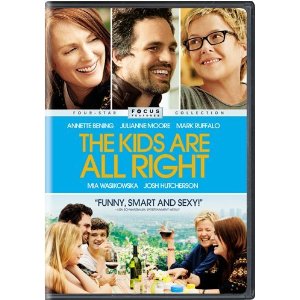
 (photo from Amazon.com)
Do you see on the cover, how the two mothers and two children are having a lovely laughing lunch on the patio with the sperm donor? NO. The whole lunch is an interview of awkward bad questions and awkward unexpected answers that go over poorly (“But I distinctly remember you said in your donor profile that you were interested in international studies?” “Nah, I just ditched all that, because college is a waste of time!” “…I see”), and I just wanted to be ANYWHERE BUT AT THAT LOVELY LUNCH.
And then throughout the movie there is all this snippy bickery unreasonable psychobabble between the two women, and then there is teenagery mouthing off from the kids. And the sperm-donor guy is all laid-back and go-with-the-flowish, and sometimes people were finding it awesome that he was like this and sometimes they were finding it intolerable, and I found them annoying no matter WHAT their reaction was.
Multiple times so far while watching it I have said OUT LOUD, “Oh no no no no no” accompanied by HEAVY WINCING, and I am only on the first hour of it. I don’t like the parents or their relationship, I don’t like the children or their attitudes, and I don’t like how the donor is changing everything around. Also: gratuitous sex. BUT: I keep watching. Because I want to know what happens, and because this is interesting subject matter to mull when I’m not wincing.
Next! I finished reading The Sociopath Next Door.
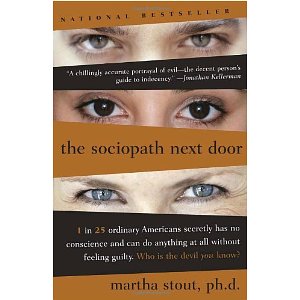
 (photo from Amazon.com)(also, I am kind of done seeing those creepy eyes now)
As with other sociology/psychology-for-the-masses books, it seems like it’s one chapter’s worth of material forced by necessity into book-length. I always imagine the authors repeatedly using word-count: “CRAP, still 70,000 words to go!!!…*checking again*…CRAP, now it’s 69,901 to go!! I’ll take out all the contractions, that’ll…I mean THAT WILL help!” I did a ton of skimming: I’d hit a section that was such a total repeat I thought I must have mis-marked my place in the book, and I’d just glide past until it got back to something new. Or I’d get to a case study that was so drawn out I felt like I was reading an actual transcription of that person’s life (MUST WE read EVERY LINE of the NEIGHBORS’ dialog? MUST WE read what they were EATING as they TALKED?), and I would skimmmmmmmmm until I got to the next little burst of actual material. I also skipped right past stories of animals being hurt/killed: I’m familiar with that part of sociopaths, and I don’t need a several-page description to remind me. It’s too upsetting to read, and not necessary.
But I strongly recommend that you read skim/read the book too, because the actual material SHORTED OUT MY CIRCUITS. I think of sociopaths as being, you know, the cold-blooded serial killers who as children tortured animals. But the author says that about 4% of the population qualifies as sociopaths, and that the definition includes a lot more than our stock image: most sociopaths aren’t violent; they marry and have children; they have jobs as teachers and psychologists and managers. In fact, ESPECIALLY those jobs.
The gist is that a sociopath is someone who understands concepts like love and empathy, but doesn’t feel them—and furthermore thinks those concepts are for idiots and cattle, and doesn’t WANT to feel them. They tend to be bored, so they play life like a game. Sociopaths can’t be “fixed,” or trained to feel those feelings. It’s not a matter of explaining how they’re hurting you so that they’ll stop, because they already know that they’re doing it, and they’re doing it on purpose for that very reason. Most mind-blowing to me: most sociopaths are excellent at FAKING that they DO feel love and empathy: tears, declarations of love and friendship and admiration, being charming and friendly and sweet, etc. If you accuse them of the things they’re doing, they’ll act hurt—while behind the scenes, they’re wondering how far they can push you to believe them instead of yourself, and whether they can make you believe you’re the crazy one. As in a mystery novel, such false clues are there for camouflage, and as part of the game. CRAZY.
Reading it, I recognized one of my mother’s former co-workers. It was very, very odd to read each sentence and think “Wait!! That’s what happened with HER!!” “Wait!! That’s EXACTLY how things went!!” I told my mother about it over lunch, and she was remembering little details and pretty much every single one was IN THE BOOK. I found it a huge, huge relief to read it and know that there was an EXPLANATION for why the world seemed to go nuts for awhile there, while other people just WATCHED—and in fact GATHERED AROUND the sociopath in support. It was so perplexing and stressful, and it makes more sense now. It was all a game, a very cleverly played GAME.
The author says that one of the odd things about experiences with sociopaths is that people don’t DO anything about it. They can’t believe it could actually be happening, and they can’t understand how a sociopath’s mind works, so they keep thinking “But how could someone do something like that? How could someone have so little regard for someone’s feelings? And WHY would they do something like that to someone who never did anything to them?” It makes no sense, so we conclude it isn’t true. And the way a sociopath sets things up, WE’D look crazy if we said anything. So we don’t, and we fit into the game.
One of the most helpful parts of the book for me was how to figure out if you’re dealing with an actual sociopath, as opposed to someone kind of mean and thoughtless, or someone you just have a personality conflict with. A sociopath will (1) repeatedly do mean or inexplicable or thoughtless or inconsiderate things, AND (2) do a “pity play” so you don’t do anything about it. The author says: “…bear in mind that the combination of consistently bad or egregiously inadequate behavior with frequent plays for your pity is as close to a warning mark on a conscienceless person’s forehead as you will ever be given.”
Anyway. I think you should read it. I felt like after I read it, I had a very different outlook on a lot of things, and felt more aware of things around me—but WITHOUT suddenly feeling paranoid about everything. It was more like “Oh!! I felt crazy about ditching that friendship/boss/boyfriend, but this is exactly how it was happening!” And also a good reminder that just because it knows how to quack like a duck doesn’t make it a duck: those of us who tend to be a little trusting of smiles and nice words can use a reminder from time to time that we can’t let those things distract us from actions that don’t match.