One thing that doesn’t seem to change about children as they get older is that they still don’t wait to bring up a difficult issue (is it teeth or is it ear infection?, is this a discipline issue or is it an issue of emotional needs not being met?, what does this decision mean for future applications of our parenting philosophy?) at a time when you’re well-rested, well-fed, and sitting comfortably and approachably by the fire sipping your after-dinner brandy and hoping for an exhilarating exchange of ideas.
Instead it is at 6:10 a.m. while the coffee is still brewing that two of them want to call in judicial moderation on the subject of whether Child One WAS or WAS NOT out of the bathroom by 6:05 as required by household law, AND whether that household law is fair and appropriate. Or it is at 10:00 p.m. as I am wearily brushing my teeth that one of the children asks why religious people can’t just follow the rules as they understand them, rather than spending most of their time monitoring whether other people are following those rules. (YES, dear children, and perhaps you could apply this new-found insight to your own CONSTANT TATTLING.)
I’ve read a lot of stuff, mostly written in metallic script on greeting cards, about how much children TEACH us. Perhaps my own children are somewhat stupider than the standard-issue child, and that is why so far I don’t feel they’ve taught me anything—and in fact, I have to spend a lot of time explaining things to them that seem really obvious, such as “This is why we don’t throw a rubber band ball at the window” and “Are you serious, scraping a FORK into the TABLE??” But what I HAVE noticed is that I teach MYSELF things as a RESULT of having children—and perhaps that’s what people mean to say but their children haven’t yet finished teaching them how to articulate their thoughts clearly.
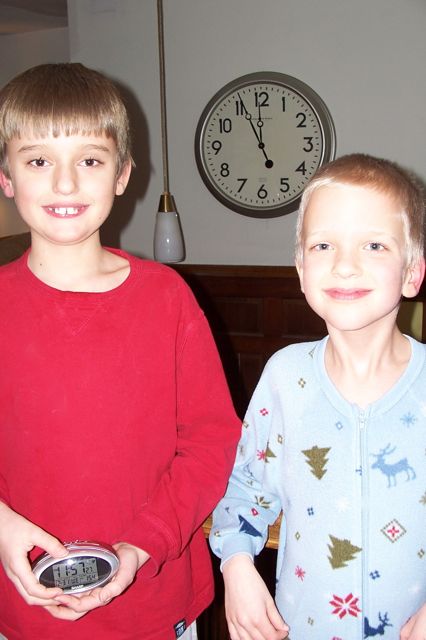
The child doesn’t come along, hitch up her diaper, spit out her pacifier, and say, “When a human failing is consistent rather than periodic, that failing can no longer be blamed on external circumstances but must instead be blamed (if blame is to be apportioned) on the human herself—either on her unchangeable nature or by her failure to make the necessary changes to her actions that would lead to a change in results.” Instead, it’s that as I teach the child this concept (“If the clock is wrong, that excuses you the first time when you didn’t know it was wrong—but after that, you KNOW the clock is wrong so it’s back to being your fault you’re not out of the bathroom on time”), I learn it better myself (“Hm. If I am ALWAYS rushing/frantic/stressed to get to kindergarten drop-off, maybe I should start getting ready 5 minutes earlier instead of blaming the child and/or the circumstances for always making us late”).
This kind of learning (I teach it to them, and that’s when I learn it better too) reminds me of some rule of education I remember hearing somewhere along the line, which is that to fully learn to do something, you should watch one, then do one, then teach one to someone else. I think it was a medical thing, maybe? Like, first you watch someone give a shot, then you give the shot, then you teach someone else to give a shot—and THEN you can say you know how to give a shot. It seems like it would take more than that to say you knew how to do, say, neurosurgery, but I get the gist: you kind of know it when you’ve been told it; you know it better when you put it into practice yourself; you know it the best after you explain/show/teach it to someone else.
It’s like a very irritating thing Paul used to say (I’ve made him stop) (I hope), which is that if you can’t successfully explain it to a 5-year-old, you don’t really know it. I can think of multiple reasons why that is crap as a hard-line philosophy (but I can’t explain it to Henry so that he fully understands concepts well beyond his developmental level, SO I GUESS I KNOW NOTHING)—but the IDEA is that in order to simplify something down to its bare bones so that even a little kid could understand it, you have to know all those bones really well.
Artists study skeletal and muscular structure even when they’re not going to be drawing bones and muscles, because they know you draw the skin better if you know what’s underneath it. Again, many an artist over the centuries HAS been able to draw excellent pictures of people WITHOUT first knowing all the bones, just as you can know you want go to the less-expensive grocery store without first minoring in economics. But knowing the bones and the economics means knowing more THOROUGHLY what you’re doing and why. The children don’t teach us in the first sense of the word (by being the ones to tell us how things are) (or at least, as mentioned previously, MY children don’t), but we learn it better when we teach them. (That doesn’t look as pretty in metallic script, though.)