Author Archives: Swistle

Reader Question: How Does a Second Child Change Things?

Jessica writes:

I am pregnant with our second. We have an almost-3-year-old with a speech delay and sometimes I feel like we are barely holding it together. We both work outside the home. Can you (and maybe readers) tell me how having a second child changes things? I am really scared.

This question gives me an immediate split response as I remember how HARD it was at first, and how FINE it was in the long run. What I remember about having a toddler (Rob) and a newborn (William) is walking around thinking endlessly “This can’t be done. This can’t be done. This can’t be done.” (When it happened again when Henry was born, I concluded that it’s something magical about the toddler-plus-newborn combination.)

But then after awhile things got more comfortable and familiar and I thought, “Oh I get it: this is what people mean when they say ‘the new normal.'” I couldn’t really remember anymore what it had been like before the new baby arrived, and when I TRIED to remember I found I was imagining it must have been a blissful relaxed time with “only one” child, and how oh how did I fill my time? But as you know, and as I knew, it had NOT been like that. In fact, it had been pretty much the same as I felt now: busy, and sometimes barely keeping things together, but other times things working okay.

It would be hard to say SPECIFICALLY what changes, or how it changes, or what that’s like. Remember before you had your first baby? People could tell you what it was like for them to bring home their first baby, and what changes that made in their lives and marriages, but they couldn’t tell you what it would be like for you—and they couldn’t really explain even their own experience well enough to give someone else a true picture of it anyway. There was nothing for it but to wait and see for yourself. Nevertheless, I can tell you some of the things that changed in our house, and others can tell you what changed at their houses.

One thing that changed for us is that it’s harder for one parent to give the other a break. With one child, one parent can take the child to the store, or play with the child in another room, and the other parent can be free. With two children, one parent can still do these things with both child, but the perceived burden will be significantly higher.

On the other hand, I found that in my particular marriage, this led to my resentment levels dropping considerably: with one child, I felt like Paul was always free to go off and play on the computer or something, figuring (rightly) that there wasn’t much for him to do while I was nursing the baby; with two children, it made sense to both of us that each of us should be taking care of someone. I would be dealing with the baby, and he would be busy, too, playing a game with the toddler; or I would be bathing the toddler, and he would be holding the baby. It gave me a feeling of balance and fairness that led to a happier household overall.

Another thing that changed for us is that a number of things started feeling more “worth it”—I’m thinking of as the younger child got older. Getting out all the painting stuff for one child seems like a lot of work; for two, it seemed like I was getting double value for my time and effort.

A fun change was how endlessly fascinating we found it to notice the similarities and differences between the two children. This was a game we hadn’t been able to play with just one child. Taking pictures of them together was also surprisingly entertaining, as was dressing them in coordinated outfits. Geez, I know this sounds lame. BUT IT WAS FUN. Really, a very pleasing side effect of two or more.

Another change was how big our older child seemed all of a sudden. It was like he was a baby that morning, and a totally competent walker-talker that afternoon. I felt like the new baby gave me a much greater appreciation for the older child’s skills—things I hadn’t noticed so much before, like how nice it was that he could tell me what was wrong, or point to what he wanted, or be set down anywhere without slumping over like a cute little slug.

And the flip of this was also true: I found I could appreciate my second child’s babyness so much more, because I could see it in contrast to the older child. Instead of feeling like his babyness was practically all used up at 6 weeks (as I did with my firstborn, although to be fair that was in the middle of a hormonal cry fest), I felt like he seemed small and cute endlessly. And I could appreciate the simplicity of his needs: he needed food, or warmth, or a new diaper, or snuggles—he didn’t need a twentieth “Why?” answer, or to have it explained why he couldn’t have my coffee, or to have me to decide how much television he could watch.

Oh dear, I don’t feel like I’m answering your question AT ALL. Perhaps now is a good time to get the comments section going.

Update! Jessica writes:

Hello! A couple of years ago I sent you this question.

I wanted to tell you how incredibly reassuring this post and the subsequent comments were. I sadly ended up losing the pregnancy I was writing about, but got pregnant again a few months later and we had our beautiful second son in May 2012.

I think the biggest lesson I learned is that babies are DIFFERENT. Our first son was a difficult, difficult baby. Everything was hard — feeding, sleeping, awake time, going out, staying in. Therefore, I fully expected our baby experience to be replicated, except also with an older version running around wreaking havoc and demanding attention.

As it turned out, our second is the proverbial “easy baby” and our very difficult toddler has matured into a only moderately difficult preschooler.

Because of my paranoia, we had arranged for a young babysitter to come play with our older son for a couple of hours a day during our baby’s first few weeks, and that made a huge, huge difference, especially as I recovered from a c-section.

But my fretting was mostly unwarranted. Older son LOVES the baby, and we haven’t experienced too many alarming backslides in his behavior. He tries to be too rough with the baby — of course — but that’s pretty easily handled. Our days are intense, but joyful.

So thank you to you and the commenters for helping me through the fretful anticipation period. As is almost always the case, the worry turned out to be much worse than the reality.
Tidying

I did SO MUCH boring-but-satisfying work around the house yesterday! I dispersed the contents of FOUR large bins from the basement shelves: some of it was warm-weather clothing that went into children’s rooms, but I put about half of it aside to be donated: I noticed we had about twice as many pairs of shorts as I needed for Edward (probably this was the size that got lost long enough I’d finally concluded the previous child had skipped the size and so repurchased it), and also I think it’s time to conclude that William is the only boy who’s going to wear slims so it’s safe to get rid of those handmedowns instead of hanging on to them just in case one of the two younger boys needs them, and also I threw out some jeans with holes in the knees—good thing I stored those for four years! My dining room will look SO MUCH BETTER when I finally remember to take the half-dozen bags of clothes to the donation dumpster.

I also took a binlet (like, not a BIG HUGE bin, but what do you call it so as not to give the impression of largeness?) of pure miscellany that Paul had dumped into it while moving furniture: all the pens and pencils and game pieces and refrigerator magnets and puzzle pieces and playing cards and small toys and pieces of possibly-important paper he found there. I’d been putting off dealing with it out of resentment: he got big glory for moving furniture, but would I get any for doing the fiddly cleaning up, even though it would take longer and be more of a pain? NO I WOULD NOT. And why would he just leave it there, as if somehow it were MY job? I went through it and tossed a lot of it (some of those game pieces were to games we haven’t had for years), and put away the rest of it (SIX rolls of tape! no wonder I can never find tape).

I also threw out a large pretty platter. It’s a neat shade of green, and it looked gorgeous sitting on our bureau with its matching pitcher on it. Until the pitcher broke several years ago. I couldn’t replace the pitcher (Target clearance, long gone), but I didn’t want to get rid of the platter, because every time I thought of doing so, I got mad about the broken pitcher again. As if perhaps saving the platter would mean the pitcher HADN’T broken. Anyway, I threw it out.

I planted a bunch of daffodil bulbs my mom didn’t want anymore, and while I was out there I planted the little pine tree I bought around Christmastime and the blueberry twig I bought to replace the one that died over the winter.

I went through a bag of Edward’s Christmas stocking stuff that turned out to be still hanging on the back of a dining room chair. I put away the few things that were in it, and threw out a handful of red and green M&Ms.

I dispersed the contents of a box I’d started as a “Donate This” box. Some things weren’t even worth Freecycling, so I tossed them out. Other things were worth Freecycling, so I Freecycled them.

I gathered up the singleton gloves I’d been noticing here and there and another-there, and put them in a drawer in the mud room. I took Elizabeth’s winter coat out of the mud room and hung it up in the hall closet. I found a pair of shoes, realized I hated them, realized that keeping them anyway wasn’t going to get me my money’s worth from them, and put them in the donation bag.

It was a lot of puttering: allowing myself to be led by what caught my eye next, instead of trying to work in a steady line across the room. And so the net effect is of a nice overall improvement, mostly in the dining room, though I also have the private satisfaction of knowing about the change in the basement a visitor wouldn’t see.

And this morning I melted a bag of frozen pineapple juice into the sink, which doesn’t SEEM like a big deal, and ISN’T, except that it marks The Attitude Change that comes with working steadily to improve the state of the household: I’ve noticed that instead of thinking, as I have for probably a year, “Oh, yeah, that bag of pineapple juice—we’re obviously not going to use that after all, and anyway I’m sure it’s no good anymore. Well, no sense dealing with it right this second if I’m not also going to deal with the bag of bread ends we’re apparently never going to feed to ducks, and also tidy up the freezer in general, and anyway there’s still plenty of room in there so there’s no rush,” I yoinked it when I noticed it and brought it upstairs with me and plunked it into the sink. Maybe later today I’ll yoink the duck bread.

The Most Difficult Thing I Got Rid Of

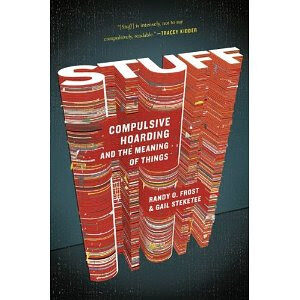
I read Stuff: Compulsive Hoarding and the Meaning of Things this past week, and if there’s a better book to set off a little spring-cleaning binge, I don’t know what it is.

(image from Amazon.com)

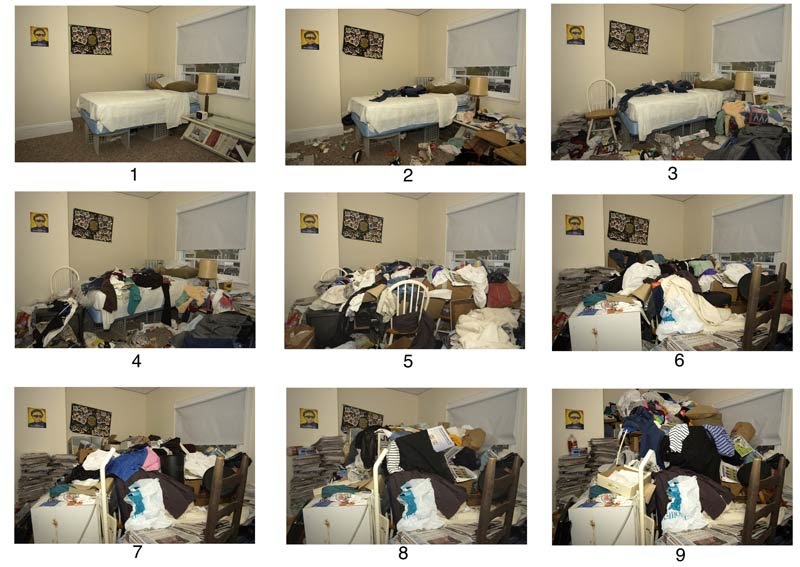
Have you seen this “clutter scale” test by one of the authors?

(I got it from here, where you can see it larger and also see other sample rooms.)

Our house is a 2, without stacks of newspapers, and the downstairs family room is a 3 because we’ve been using it as “I’ll just put this here temporarily” storage since it was built.

What I love about this chart is that I can SEE why a 2-3 feels hopeless and out of control (that is, I don’t feel silly for feeling that way)—while still receiving comfort that I’m low on the scale. My goal is to be somewhere between a 1 (which looks BEYOND tidy to me—like when I was a child and if I left a book on a chair when I went to the bathroom, my mother would close it and put it away on a shelf while I was gone) and a 2.

This weekend I tried to use some of the ideas I got from the book and from a couple of other articles I’ve seen on the topic of decluttering and from my own thoughts—ideas like, “Could I replace this easily if I regretted getting rid of it?” “Have I used it in X years and/or do I have reason to believe I will use it?” “Do I still feel distress AFTER getting rid of it, or only when thinking about getting rid of it?” “Does it bless or oppress?” “Do I consider it my job to be the caretaker of this item forever?” “Is saving it in my basement less of a waste than getting rid of it?” etc.

I got rid of three clocks I’ve been storing because clocks are useful even though I don’t like them and have replaced them with others. I got rid of a 3-foot stack of carefully-acquired Ladybug magazines that my firstborn loved with obsessive passion when he was 2 and none of the other kids have given the time of day. And two twin-size duvet sets I thought I’d use for Rob and William’s bunks 8 years ago but then didn’t. A bedskirt I got for Elizabeth 3 years ago but it didn’t work with her bed frame. A 2-foot stack of partially-used children’s workbooks. A package of size 2T-3T pull-ups bought on an awesome clearance and then never used.

All this is leading up to something I got rid of that I’d say might have been My Most Difficult Thing to Get Rid Of. It’s something I’ve been gradually accumulating for a decade, and have thought MANY TIMES that I should get rid of—but then couldn’t. I’ve felt simultaneously “The Owner of Riches” and “The Crazy Person Who Needs Help” over them.

It’s twin-sized flat sheets. I make the kids’ beds with only the fitted sheet and a blanket. But I keep the flat sheets, because what else could I do with them? THROW AWAY a perfectly good flat sheet, still new and folded, half the material/value of the package of sheets I just paid for? If I tried to donate it, who’d need JUST A FLAT SHEET? And what if when the kids were older I started using the flat sheets again? What if when the kids were grown I used the twin sheets on guest beds? Besides, they’re so handy as drop cloths and haircutting drapes! And so many of them are so PRETTY! And they’re FABRIC, and fabric is USEFUL! Fabric is a SUPPLY! If I knew how to sew I could use them to make quilts! or clothes for the children, Sound-of-Music style! Or I could make curtains that perfectly matched the bedding! And it would be perfect if I ever did that idea of wrapping gifts in pieces of fabric instead of wrapping paper! And what if there were an apocalypse? FABRIC IS USEFUL AND VALUABLE AND THESE ARE PERFECT HEMMED PIECES OF IT.

So I saved them, and continued to save them. We have five twin beds in our house, and we’ve had trouble with night-training more than one of the kids so I like a large supply, and also we use cotton-weave in summer and flannel in winter, and also I am always finding cute ones at 75% off, which is my way of leading up to the information that I had over 30 twin-sized flat sheets in a closet—and that’s not counting the three I stored elsewhere as drop cloths and haircutting drapes. They took up 1.5 shelves in a good and useful closet. When I loaded them into bags for a Freecycler to pick up, they filled two large black garbage bags TIGHTLY.

I did save two of my favorites. They were the ones that, when I tried to put them in the bag with the others, I thought to myself, “No, never mind, this is a bad idea. I’ll just put them all back on the shelf.”

Planned Family

As I’ve previously mentioned, I went to a Christian college. I was dating a nice Christian boy by the third month of my freshman year. I was friends with a married junior/senior (when I was freshman/sophomore) girl named Lisa, and I remember her advice: “If you’re NOT going to Wait, put off getting married until it’s practical. If you ARE going to Wait, get married early.”

My parents approved of this advice. I got married halfway through my junior year of college. I turned 20 in time for the wedding.

Here was our first practical problem: we were both full-time students at a Christian college. We could get excellent health care through the Student Health Center for practically nothing—but they wouldn’t prescribe birth control: it was a Christian college, and if you prescribe for SOME students, where do you draw the line? It’s a slippery slope. So even married students couldn’t get birth control. But we didn’t have full-time jobs, nor were we still under our parents’ care, so we didn’t have any other options for health insurance.

I went to Planned Parenthood, because we’d heard they charged based on how much money we made. I worked part-time in the library and my husband worked part-time for the department he was majoring in, and so I paid something small, something like $40, which we could just barely afford, for the exam that checked me for breast cancer and Internal Feminine Cancers, and then I paid $5/month for birth control pills to keep me from getting pregnant before we’d finished our education.

********

Fast-forward to late 2001. My husband and I had two children ages infant and nearly 3 years, and my husband lost his job: his company’s main client was in the World Trade Center. With the lost job, of course, went our health insurance. I got a full-time job, but my earning power was low: I made $8/hour. At that income level, our family qualified for free government health insurance for the children, so we took it. Because I was working for $8/hour, Paul and I didn’t qualify.

If we’d had another baby during this time, I and the baby would have been covered completely by the government. This was not a desirable state of life for us, despite the benefits, but my OB/GYN wouldn’t prescribe the Pill without an office visit, and an office visit was significantly more than we could afford. So I went to Planned Parenthood.

Again, they decided our payment based on our income. They checked me for breast cancer and various Internal Female Cancers, and I paid $10/month for birth control pills. It would have been cheaper if I’d gotten pregnant and let the government pay for our lives, but that wasn’t the way we wanted to play it.

********

Paul is a contractor for a company that does government work, so if there is a government shut-down, Paul is out of a job. Because he’s a contractor, he’s not eligible for reimbursement when the bickering is over.

Reader Question: Sleep Issues 3

Jessica writes:

Please help me! I know you don’t do these often, but you do them sometimes. Will you do one now? Will you HELP. ME? I’m hoping you and your fantastic readers can help. Ava is 10 weeks old now and the kid does. not. sleep. She still wakes up every 2-3 hours to eat. And it takes her 45 minutes to eat a 4 oz bottle, so if you do the math (I can’t, I’m sleep deprived) I think I’m getting like 18.4 minutes of sleep at one stretch. My boyfriend works out of state, so he’s rarely home so it’s just me and my 10 year old and I’m pretty sure asking her to get up with the baby is a bad idea. I read “Becoming Baby Wise” because a friend swore that it helped her get her baby to sleep…I read it, and I don’t get how it helps your baby sleep. In addition to her constant waking at night, she also doesn’t nap. She’ll take a 15 minute cat nap here and there, but that’s it. I’ve tried letting her sleep in her bouncy chair and her swing, doesn’t make her stay asleep longer. I’ve tried laying her down in her bassinet or her crib when she’s looking sleepy, she wakes RIGHT up and is pissed. I’ve tried letting her “cry it out”, and I hate it. I did it for 30 minutes and she just got more and more mad to the point where she started choking. (Can’t do that at night anyway, because the 10 year old will wake up!) The only way I can get her to sleep during the day is if we run an errand (but it has to be longer than a half hour), she’ll fall asleep in her car seat and then I just leave her in it when we get home (I know, I’m mean). I realize she’s only 10 weeks old and she’s BRAND NEW, but when I read that 10 weeks old require 15-18 hours of sleep, I want to cry. Here’s what we’re doing now: 9pm, bottle, bed time routine & asleep (was doing 7pm, but she wakes up at 10) She’s up at 11, 2, 5 and then 6:30 (we never leave the nursery when she wakes) and SOMETIMES I can get her back to sleep until 8. I’m exhausted, my parents have offered to come over during the day to let me nap, but I am seriously incapable of sleeping during they day, unless I drug myself into it, and then I’m a mess the rest of the day. I have to go back to work soon, and there is no way I’ll be able to function like this. Do I just have to wait, or do you have some killer advice? I’m hoping between you and your readers, someone can help! I’m going crazy. I realize this email is all over the place, but my brain function is limited these days. If it helps to know, she’s bottle fed (formula).

Oh, dude, I SO WISH I had AWESOME EXPERT FIVE-CHILD ADVICE for you, but do you know, I don’t think I EVER successfully solved a sleep issue, or at least not without another issue cropping right up. I consider them NIGHTMARES to handle. I will tell you EVERYTHING I KNOW ABOUT SLEEP, and it will not take long:

1. That thing I read a few other places, about the baby’s first nap of the day being about an hour and a half after the baby wakes up. This BLEW MY MIND because it seemed so counter-intuitive: why would the baby go back to sleep again so soon after waking? But indeed, if I put my babies down at about that interval, they DID go to sleep. (This does not mean it will work for your baby; see #2.)

2. That babies are SO DIFFERENT about sleep, and that what works for one person works for someone else only by SHEER COINCIDENCE. This can be excruciatingly annoying when you’ve got a Poor Sleeper and a friend is telling you that if you would “just” do X and Y, YOUR baby would sleep like HER baby did. When actually what it was, was that she got a Good Sleeper and is crediting her Awesome Techniques for it, and/or that her baby happened to respond well to the particular technique. This is one of the areas where I feel like working in a daycare did me HUGE FAVORS: the more babies a person handles, the more a person is forced to accept that some babies work one way and some babies work another way and there isn’t much that can be done to change that.

3. That it also matters what works for YOU the parent. As you’ve noticed, some people can nap during the day and some can’t. People have different levels of tolerance for crying, and different abilities to adjust to different levels of sleep. People also vary tremendously in their willingness to do certain things such as swing sleep, tummy sleep, car sleep, on-me sleep. What works for you will be different than what works for another parent, just as what works for your baby will be different than what works for another baby. And this may change over time.

4. It is worth continuing to try things. There are so many stories of families that struggled and struggled and struggled and struggled, and then they tried their hundredth thing and THAT worked for THEIR baby.

5. But if it DOESN’T happen like that, see #2.

6. Are you able to doze in a recliner while you feed her at night? I did that for a lot of night feedings, but I know people vary in their dozing abilities. I used a lot of pillows to prop everything securely, and then I’d drift off. Sometimes this meant I woke up in the recliner in the morning, baby asleep next to me.

7. When you go back to work, will she be in daycare during the day? I’ve heard encouraging stories of daycares sleep-training the child during the day, which then results in better nighttime sleep as well.

And now let’s turn it over to the group, because THAT is where I think the valuable advice is: when you can see a huge pool of advice like that, you can see the amazing variety of possibilities and you can pick-and-choose and try different things.

(You can also look at the comments from two previous sleep-issue questions: this one is my favorite and I say a bunch of things I would have also said to you except I felt self-conscious about repeating myself, and this one is also my favorite, for the same reasons, and the comments sections on both posts are SO GOOD.)

Pap, Baby Sadness, Geek Love

May I impose upon your time and squeeze from you a moment of sympathy? Because my pap test, which I left 6 months overdue because of phone phobia -slash- scheduling hopelessness, and then had a HORRIBLE conversation with a receptionist that led to me making the appointment with a doctor other than the one I wanted, as if I didn’t PLENTY dread the appointment already—THAT same appointment led to a test that had “insufficient cells for analysis” and I have to have A DO-OVER PAP TEST. I am not even kidding. And, as the doctor I didn’t want (who turned out to be okay, but THAT IS NOT EVEN THE POINT) said, I “do not seem like a woman who has five children.” That is, THIS IS A VERY UNCOMFORTABLE TEST FOR SOMEONE WHO HAS HAD ONLY C-SECTIONS.

Thank you. I appreciate your sympathy/pity. Thank you. Yes. Keep it coming. Thank you so much.

Speaking of that general area of the body, I have had Baby Sadness today, a particularly bad spike of it. I told Paul that it seemed pretty dim that just when I would feel like I couldn’t manage/appreciate the five I had, and just as I wished we could flash-forward five years and be done with some of this crap, that I would be plagued by Baby Cravings. And Paul said no, it made sense to him: that when our current children were being all smelly and unpleasant and disobedient, it seemed appropriate I would crave a nice fresh newborn. (His eyes were kind of damp too, I’ll note. He’s not as crazy about the newborn stage as I am, but he is very fond of the Post-Newborn Baby stage.)

I’m so grateful that some of you are expecting babies. It helps so much. I know that some people, when experiencing Baby Sadness, resent pregnant people—-but I, probably because I have FIVE CHILDREN OMG THAT IS TOO MANY CHILDREN FOR RESENTMENT IN ANY FORM, feel comforted: it gives me a feeling of “There will still be new babies and new-baby happiness and new-baby excitement, even if they are not MY babies.”

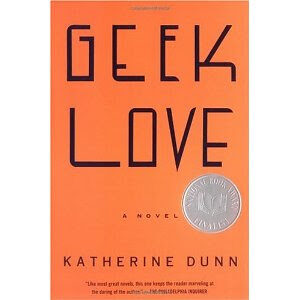
Speaking of whatever we were speaking of and how it applies to this next topic, I don’t know which of you recommended the book Geek Love, but whoever it was did a really short review along the lines of “I can’t even describe this book but it blew my mind and you should read it.” That is how I feel about it as well. I can’t even describe it—or at least, not without totally misleading you. It blew my mind.

(image from Amazon.com)

I finished reading it the day before yesterday, so I’m far enough away from it to safely say I really, really liked it. And yet—it is the sort of book I would be reluctant to recommend. It reminded me of when Paul and I watched the movie Up with my parents, and all four of us were first all weepy (okay, TWO of us were weepy), and then we were all WTF?? and then we were laughing, and then back to WTF?? and so on. We had NO IDEA where that movie was going. Same with Geek Love: it had computer-geek font on the cover and computer-geek orangey-yellow on the cover, but IT IS NOT ABOUT THE COMPUTER KIND OF GEEK. And I don’t even know if I recommend it to you or not. I leave it as the reviewer I read left it, which was basically, “I can’t even describe this book, just read it.” [Edited to add: Okay, this is interesting. We have documentation (comments section) that this post from Hilarity in Shoes is what caused me to add the book to my library list. And yet, that’s not the review I’m thinking of.]

Recurring Dreams

Elizabelle posted today about elevator dreams and I got all excited because I have SO MANY elevator dreams. So many! They’re ALWAYS stressful dreams: I can’t find the right elevator, or it takes me to the wrong place, or it’s broken, or I can’t find / figure out the buttons, or whatever.

I also have a recurring “Finding a room I didn’t know we had” dream. These are ALWAYS good dreams, good enough that I feel sad when I wake up and we DON’T have an extra room. Sometimes the extra room is a whole BUNCH of extra rooms: I open a door and there’s a whole WING, a whole HOUSE WORTH of rooms to explore.

I used to have the “finding money” dream, where I’d see a quarter in the sand by the side of the road, and hey, under it is a dime, and now I see another quarter and two more dimes, and OH MAN there is a RICH VEIN of coinage here! I haven’t had that one in ages.

Unpleasantly often I dream that I’m having a confrontation with someone, and I get so angry I start trying to hit them but my arms are too weak to manage it, which makes me even angrier and also I’m crying with frustration and also I’m feeling awful about trying to hit them and shocked at my impropriety.

I frequently have “packing” dreams, where I need to pack for a trip or for an emergency or for a move, and I just can’t get organized and the time to leave is getting closer and closer. These are usually stress dreams, but sometimes can be pleasant if I’m more organized and having some success with the task.

I can’t remember where it was, but recently someone wrote something about how you have school dreams for “a few years” after leaving school—but I left school fifteen years ago and it’s still one of my most common dream themes. Usually it’s the “can’t figure out my schedule, can’t remember what class to go to next or where the classroom is, can’t find my locker” variety. Once I reassured myself upon waking from a particularly drawn-out and unpleasant example of the genre that if ever such a thing DID happen, of course I could just go to the school office and they’d help. So then the next time I had the dream, I remembered that—and I couldn’t find the school office, and when I DID find it no one was at the desk. Thank you, brain, for kicking that comforting thought out from under me!

Sims, Buckets, Shirts

I’ve been playing Sims again, and MY GOODNESS I would like to re-recommend this game to anyone anticipating a baby, because it was one of the reasons I survived post-partum: it gets you in the mindset of improving overall mood by doing whatever is possible (e.g., even just PEEING helps considerably), and it reinforces the drops IN the bucket idea. I’ve found it useful even now, when I’m not post-partum but HAVE been in a bit of a MOOD. Playing Sims again has made me start thinking in terms of “little things that will make me feel overall better.” If I’m starting to kick the cats (NOTE: I do not really kick the cats) or yell at the children (NOTE: Er…), I have a little snack and then I clean up one small thing and then I get a drink of water and then I spend a little time reading a magazine, and gradually the diamond over my head is greening up.

Speaking of buckets (it was like mid-paragraph), I’m so glad to see the summer toys back in stock at Target, because we needed a new Barf Bucket and those are hard to find off-season. I got a nice colorful pail for I think two dollars, and this time I put it up high so no one would use it upside-down as a step stool -slash- launching platform, which is what happened to our previous Barf Bucket. These beach-toy pails also make good Easter baskets or egg-hunt buckets: they’re several times sturdier than the plastic Easter pails sold one section over.

Yesterday my mom and I were out and I decided I needed a new shirt, so I tried on a dozen. I found one I liked, but it had a hole in it and there weren’t any others. I found another I liked, but it was cotton weave and it was belted, and I don’t know if I would wear a belted shirt after living through the 1980s. All the rest were depressing: why are SO MANY plus-sized shirts designed for OLDER LADIES? I am aware of the whole “gaining weight with age” idea, but surely we are all also aware of “being that weight to begin with”? So shouldn’t there be a RANGE of shirts, some designed for old ladies and some designed for…I guess “young” wouldn’t be quite the word anymore, but YOUNGER ladies? Being plumpish doesn’t mean I want sequins and big distracting patterns and those drapey little sleeves and everything in rayon. And some of them were even “juniors plus” so they were INTENDED for young fashionable girls and yet they STILL looked like Golden Girls. What I wanted was the cute shirts I saw in the “misses” sizes, but LARGER.

Cheeseburger Without Cheese

Sam Harris on the lack of need for the word “atheism”: “Nearly everyone rejects Zeus, Thor, Isis, along with the countless other dead gods of antiquity, and yet no one feels the need to name this condition of unbelief.” I liked the sound of that until I realized this: “theism” means the belief in ANY god, not ALL gods—so an “atheist” would mean specifically someone who doesn’t believe in a single one of them, as opposed to someone who, as typical for a theist, believes in one god or a certain group of gods, but not the others. There isn’t a need to “name the condition of unbelief” of those who disbelieve in specific ones of the available gods, because that’s already got a word, which is “theist.” It makes sense to me that if pretty much everyone who believes in a god or gods believes in some but not all gods, that we WOULD want a specific word for someone who believes in none of them.

But his point stands even if I think it wasn’t well-illustrated by that particular example. He goes on to say that we don’t have special words to indicate our lack of belief in most other things. I don’t believe in horoscopes, but no one makes me identify myself as an anti-astrologist, and no one asks what horoscope-related trauma caused me to give up my faith in horoscopes. Did I perhaps have a bad experience with people who DID believe in horoscopes? Do I realize that horoscopists aren’t perfect, just predictable? I should try THEIR newspaper’s horoscope, because if I was trying some OTHER newspaper’s horoscope, of COURSE I didn’t feel like it was for me. Etc. Nor do I have to call myself a non-vegetarian non-Gemini non-doctor.

Having a word that means “not-that” helps give the impression that “that” is what’s normal and right—as opposed to “that” being an addition to the standard model. Better to have words for “plain” and “plain plus the religion option,” rather than to have words for “plain plus religious” and “plain plus religious but minus the religious.” Better to have “hamburger” and “cheeseburger,” rather than “cheeseburger” and “cheeseburger without cheese.”

********

As I do each year, I have a sticky note on my computer monitor with “APRIL FOOLS’ DAY” written on it. Otherwise (or perhaps I should say “Even so”) I tend to fall for things, like the year I believed the most popular rock station in our college city was changing to an all-polka format. Or the year I believed Google had started a dating service, which I STILL think was an AWESOME IDEA. (Did you see this year’s Google prank?)

Every year I hope not to fall for a fake pregnancy announcement: I’d get so happy and excited, and the disappointment of finding out it wasn’t true would be so awful. So far I haven’t fallen for one, but I did fall for one on a non-April-1 day when a Facebook friend did the “I’m expecting!!” joke where the punchline is “…snow!,” so I got a sample of what that feels like (“really good followed by really bad”).

What a Mammogram is Like (Get Your Refrigerator Ready)

I have a little cold, and if I thought the universe was a sentient prissy jerk (and that I myself wasn’t part of that same universe, a la “There’s only one everything”), I would theorize that this cold was my payback for being happy about my good test results from my physical: nice low cholesterol, everything normal with thyroid and blood sugar and so forth—I don’t really know everything they tested, but they made a whole bouquet of little bottles when they were drawing blood, and everything was normal/low/high where applicable. So, in good health for now according to the standard markers, though heading for the time of life where we all start getting things and it’s a matter of what do we get in THE DRAW.

I also had my first mammogram. If you are a little nervous about your first mammogram, as I was, I will tell you how to get a good idea what it’s like. Go into your kitchen, or I guess it doesn’t have to be YOUR kitchen but I do recommend it for privacy reasons. Take off your shirt and bra. Then take one mammo, and lean it into the open freezer, or refrigerator if you are shorter or have one of those freezer-on-the-bottom fridges—whatever’s at the right height for you.

Now you are going to start to close the door, slowly. You will need to reach in and pull/stretch the mammo into the fridge or freezer pretty firmly, or else it’ll just pop out as you close the door. You know that unflattering “orange in a sock” image people use? The orange should be fully into the fridge, with the door closing on only sock. You are right if you’re suddenly thinking that the “orange in a sock” analogy never really worked, and that this can’t work either and the orange will HAVE to be squashed.

Continue closing the door until you are ALMOST in pain: you should have a slight panicky feeling about impending pain, combined with an impulse to pull yourself out of the situation, combined with the strong feeling that pulling back at this time would lead to a worse feeling. There will also be a scraping feeling as the edge of the door travels tightly across the skin surrounding the mammo. Now hold still. Hold still, hold still, hold still—30 seconds. Open the door. Whew! Do it once more on this side, then twice on the other side. Done!

It was not as bad as I’d feared, though I was glad as usual to have been pessimistic and anxious about it, if only for that delightful “Hey, THAT wasn’t so bad!” feeling afterward.