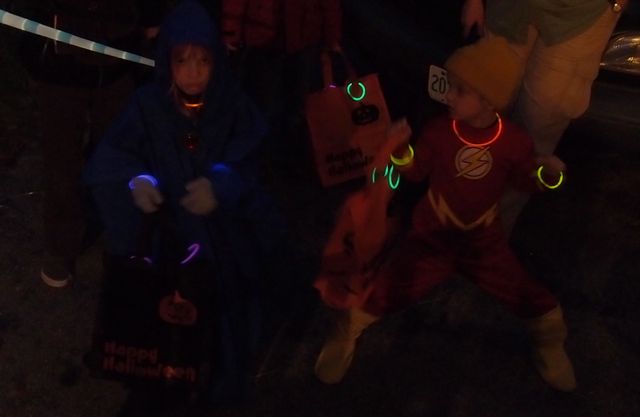
I want to make a note for next year: glow stuff is THE BEST HALLOWEEN IDEA EVER. I got a pack of 15 glow bracelets in the Target dollar section for, as you might suspect, a dollar, and I also bought three glow necklaces and a pair of glow glasses. The glow glasses were not a great idea (Paul wore them and looked awesome, but he said they messed with night vision), but the rest of it was great: the kids were SO INCREDIBLY MORE VISIBLE than the kids without glow stuff on. Each kid wore a bracelet on each wrist, and a bracelet on each strap of their trick-or-treat bag, and if I’d thought of it I would have put a bracelet on each ankle as well. (Next year I’ll spend TWO dollars on glow bracelets!) Taking motion photos outdoors at night rarely goes well for anyone, but this gives the GIST of what two kids look like in the dark if they’re wearing some glow stuff:

I had some costume triumphs this year. The best one was Elizabeth’s costume: she wanted to go as Raven from Teen Titans, and I didn’t want to spend $40 on the costume + shipping, so I tried for DIY/homemade. Here’s what Raven looks like (I would like to credit this image, but it is ALL OVER THE PLACE uncredited, so here it is with thanks and credit to whoever it belongs to):
Looking at Raven, I’d say her most important feature, costume-wise, is that cloak. I looked into buying just a cloak, but that was in the “might as well just buy the costume” league of expensive. My mom offered to sew one, but that looked like it was going to end up more expensive and time-consuming than would be worth the savings.
Here’s what we did: I bought a $4 one-size-fits-most blue rain poncho (the kind that comes in a little packet) and cut up the middle allllmost to the top (leaving the neck opening intact). I also ended up cutting a long strip off each side to make the sleeves shorter. It was PERFECT.
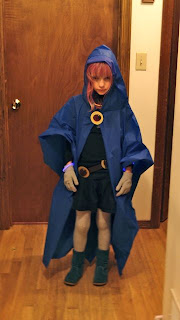 |
| She’s trying to look crabby like Raven |
For the jeweled belt/brooch, we happened to find some of those big-version flat glass vase-filler things at a consignment store (if I’d thought of using those glass things before seeing them at the consignment shop, I would have looked at a craft store). Paul happened to have four flat round metal things to hot-glue the big red glass things to, but if he hadn’t had those I would have used cardboard painted with gold paint. (And if we hadn’t found the big red glass gems, I would have used circles of red paper, maybe with saran wrap over it for shine.) Then I hot-glued the glass-on-metal-circles to an old belt, which she wore backwards so the buckle wouldn’t show. (There was originally another round thing on that belt, but it fell off and got lost at school.) I glued one more glass-on-metal to a clothespin, which I clipped to the top of the cape-cut as a brooch. (I colored the exposed part of the clothespin with a blue Sharpie.)
She wanted a black leotard, but those are not cheap. Instead I had her wear a black turtleneck and dark navy skirt. She wanted slouchy purple boots; I had her wear her dark turquoise ones. Raven’s skin is grey, so she’s also wearing grey tights and grey gloves we already had (both from Target: tights $4, gloves in a pack of three pairs for $2). I used a $1 tube of white face paint to make her face pale-but-not-clown.
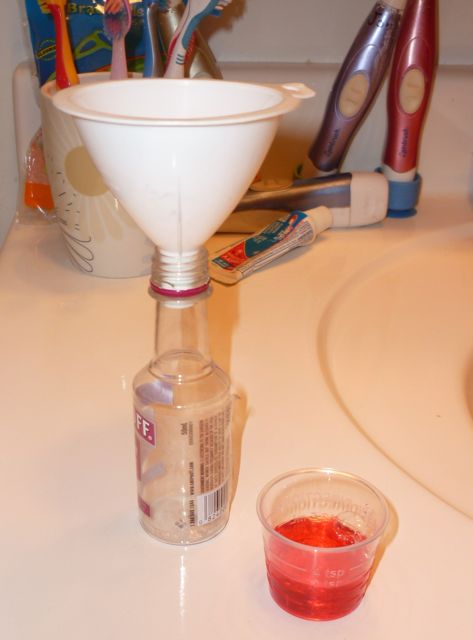
The main disappointment was the hair: Raven’s is blue-purple (it looks VERY PURPLE in the image above, but it’s described as midnight blue), so I bought a $2 can of purple hair spray. It says clearly on it “Cap indicates color.” No, it does not:
It was PINK. Bright pink! The cap is DARK PURPLE! Well. We got over it, but it was disappointing.
(She was compensated by the fact that it DID NOT WASH OUT. So she gets to go to school today with pink hair! Whereas I consider that a second disappointment with the product.)
Also a little disappointing: we forgot to put her jewel sticker on her forehead, which a brother helpfully pointed out when it was too late to do anything about it. But our PLAN was to use a jewel from a Sticky Mosaics set she has; if that wouldn’t stick, I would have used a washable red marker to draw one on.
But what surprised me in general was that it didn’t have to be The Same in order to Look Right: no one is holding up a picture of Raven to compare and then saying, “Wait, her boots are supposed to be PURPLE” or “That skirt looks NAVY.” What’s important is THE GIST.
The other costume struggle-ending-in-success was William’s. He wanted to be Luke Skywalker, but JEDI Luke Skywalker. Which basically looks like a guy wearing black/brown clothes. Since William is 5’4″, I thought we were already pushing the trick-or-treat thing without also making it look like he didn’t bother to dress up. So I made him look more dressed up with a belted brown towel, and I felt like he REALLY DID suddenly look much more in-costume:
 |
| (I evened up the ends of the towel after seeing this photo) |
The other crucial element was, of course, the sword, which glowed in the dark. It was $8 at Target, but then that was the total cost of the costume. I have been informed that it is The Wrong Color, but there were two color choices, red and blue, so I got blue.
This outfit showed me that Doing Something almost always looks better than Not, even if the Something doesn’t really make Sense. That is: even though the towel is not an accurate representation of any part of a Jedi costume, he still looked MUCH MORE like a Jedi with it than without it.