Here is the order in which I have been on a Jincy Willett kick:
(photo from Amazon.com)
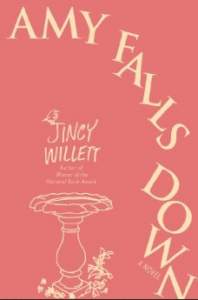
First: Amy Falls Down. I found this on the library’s New Books shelf and thought it looked like just my sort of thing. When I finished the book (having confirmed my guess about it being just my sort of thing), I noticed there were quotes on the back of it from David Sedaris and Augusten Burroughs. I looked up Jincy Willett online, and found that David Sedaris is the guy who brought her to national attention. Which is interesting when combined with the plot of Amy Falls Down, which is about an older female writer who is brought to national attention by lucky fluke.
All through the book I kept saying to Paul things like, “This is DIFFERENT. This is my kind of thing, but in a way I can’t figure out how to say it.” There are a few authors I’ve reacted to this way over the years: I’ll be reading along and I start thinking, “Wait. What is this. What is happening here.” Authors who make me lose appropriate punctuation. I’m not saying YOU will necessarily feel the same way, but David Sedaris and I are in agreement and maybe you would be too.
(photo from Amazon.com)
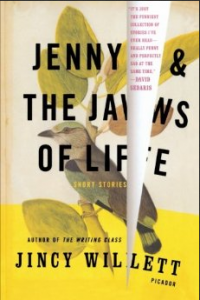
Next I requested Jenny and the Jaws of Life through the library system, because our library didn’t have a copy. I liked this book less. One reason is that I rarely like short stories. (They are too short, which is similar to the reason Paul’s grandmother didn’t like cats: “Too soft.”) But also, I felt like I was pushing my way through character summaries rather than reading a story. “Can we stop talking about what this person is LIKE and instead move the plot ahead just an INCH?,” I would think, my punctuation having returned to me. And I was left feeling depressed and upset after most of the stories, and I prefer not to feel that way unrelentingly even if the dismal stories are very nicely-written, so that was the final blow. I still liked the book, even though it sounds like I didn’t, but I’m glad I didn’t start with it or I might not have tried others.
(photo from Amazon.com)
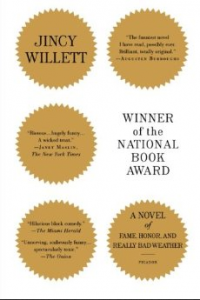
Next I read Winner of the National Book Award. It was dark, like the short stories, but longer. Character descriptions felt worthwhile because we were going to be spending so much time with these people, and because the plot did keep inching forward. (Though I would sometimes have to put the book down because I felt worn out waiting for the next inch.)
This is the kind of book where you know upfront that something bad is going to happen: in this case, that the narrator’s twin sister is going to kill her husband (her own husband, not her twin sister’s) (the second twin sister’s, not the first twin sister’s) (okay, so the sisters are Dorcas and Abigail, and Dorcas is the narrator, and we know from the start that Abigail is going to end up killing Abigail’s husband, is THAT clear?). And then you jump back so you can work toward this Bad Thing That’s Going to Happen, feeling jumpy about it and wondering how/why it’s going to happen. And then it turns out there is another layer or two of things to anticipate.
It wasn’t cheery, but I liked it. I kept pausing to re-read particularly good parts, wishing it worked well to quote little pieces to someone who wasn’t reading the book. (It never does, which is why I dislike Meaningful Quotes.) (Unless they are meaningful to ME, in which case they’re marvelous.)
Thinking over it afterward, I find I still don’t feel like I understand the characters (despite all the description), so Amy Falls Down is still my favorite.
(photo from Amazon.com)
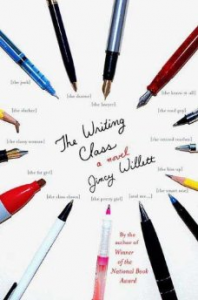
Now I am reading The Writing Class. I am only a little ways into it, but I see it comes before Amy Falls Down. You definitely don’t need to read this one first, and in fact so far I’d advise against it. The narrator (not the author, as the author keeps using her narrator to remind us) is trying a blog, and the way I feel about what she says about bloggers and blogging is very similar to the way the narrator (and perhaps also the author) feels about the things everyone says to her about fiction-writers and writing fiction. I’ve nevertheless already found several parts to wish I could read aloud to someone, though, so clearly I am ENJOYING it, it’s just that she happens to be hitting some of my personal irritations. [Edit: The part that was irritating me is over, and now I really love it.]
To sum up: I recommend trying the author. I recommend starting with Amy Falls Down or else with The Writing Class (The Writing Class is meant to be first). [Edited to add: I finished The Writing Class, and now would recommend reading that first, then Amy Falls Down. But Amy Falls Down stands alone, if you only want to read that one, and/or if you don’t like mysteries.] If you notice a self-conscious stiffness to this post, it’s because the narrator-who-is-not-the-author says she uses Google Alert on herself.