Author Archives: Swistle

Doing Something

“I really advise talking to yourself less.” That is something I just said literally out loud, to myself.

Things are usually a little grim at the beginning of a school year, which is more surprising now that this means everyone leaves me alone for a big chunk of the day. I can picture Earlier Me looking at the situation with open-mouthed astonishment: “You have the house to yourself for HOURS A DAY and you are STILL mopey??”

It’s odd how difficult it can be to do the things that I KNOW will make me feel better. I finally got a start on it by making those things very, very small. Eat one baby carrot. Walk around the house one time. Take a vitamin. Drink a glass of water. Sit in the steps for a couple of minutes and look at the trees.

One of my relatively new techniques to fight off sad/bad feelings is to try to be interested in something, ANYTHING. It doesn’t have to be a BIG thing: it can be the “one baby carrot” of interest, which would be something like “look up one thing on Wikipedia.” In this case I managed to reel in a bigger interest, which is Jane Austen.

I’ve tried Jane Austen books several times over the years: they’re so famous, and it’s embarrassing to me that I get her confused with the Brontë sisters (I also get individual Brontë sisters confused with other Brontë sisters), and I like to be familiar with famous things so I don’t feel dumb when the subject comes up. But I just couldn’t slog through the books: so many commas! so many now-obscure social practices! such odd dialogue, heavy with meanings that completely elude me! They’re about 200 years old now, and even the sentence structure was hard to get used to.

What broke me through was watching the MOVIE Pride and Prejudice, and I think my only real motivation was seeing Colin Firth as Mr. Darcy. I found, though, that it opened the book RIGHT UP for me: the people making the movie are from the same time period as me, so they basically translate it into what I can understand: even when the dialogue is quoted verbatim, the delivery of the line by Colin Firth a modern speaker does wonders for comprehension. I added the annotated edition of the book to my wish list, because I thought that would give me even MORE translating/help, plus I wanted to know more about things like “I can tell by one character’s reaction that she was just insulted—but why was that insulting?” I didn’t READ the book after receiving/unwrapping it, but I did add it to the To Read shelf. (This is a practice Paul finds very frustrating. He thinks if I don’t read the book right away, it means I didn’t really want it. He is incorrect.)

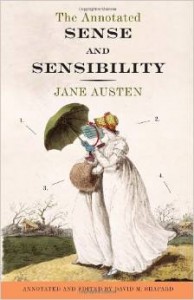
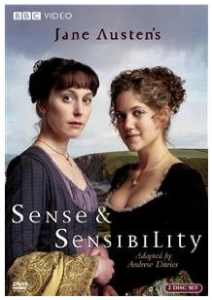
Next, encouraged by Pride and Prejudice (and by Alan Rickman and Hugh Grant), I watched Sense and Sensibility. I liked that one TOO! I still hadn’t read the annotated copy of Pride and Prejudice, but I added the annotated copy of Sense and Sensibility to my wish list, and after the next gift-exchanging holiday it was mine.

The same pattern happened with Persuasion. (I’ve learned, incidentally, that there is HEATED CONTROVERSY about which movie versions of each book are Best. I found it boring and stressful to read the debates, so instead I chose which version to watch based on which actors I wanted to see.)

Several times, I thought about reading one of the three annotated books, but now it felt like it had been too long since I’d seen the movies. It became one of those things I’d get around to SOME day, but for the time being there was a certain layer of dust involved.

Back to the current situation. I was moping around in my nice quiet house, feeling extremely stupid for feeling sad. My goal was to lug myself out of it with the help of a new interest, but nothing seemed interesting and also I was battling that silly feeling that it had to be an enduring/consuming interest or else it wasn’t worth pursuing. My eye lit upon the little stack of books, and I felt a flicker. Grabbing that flicker and feeding it some tiny twigs, I looked up Jane Austen on Wikipedia to see which book she wrote first; it was Sense and Sensibility. I ordered the movie from Netflix, and yesterday I watched it. Then I started reading the annotated book, which so far is GREAT.

I think this may be the first time I’ve read an annotated book. I was familiar with them in general because Paul has a few of them, and it is nearly impossible not to keep commenting aloud while reading one. Apparently.

This is what an annotated book looks like:

OLYMPUS DIGITAL CAMERA

On the left page, it is the original book, but with little numbers next to things. On the right page is a list of those same numbers, with comments. On this pair of pages, the comments include:

1. A definition for a word whose meaning has altered a bit in 200 years.

2. A remark about what will happen later, and how this relates to the way a character is described throughout the book. (Annotated books are best if you’re already familiar with the plot, because the annotations are FULL of spoilers.)

3. What a passage in the book indicates about a character’s temperament.

4. What another passage in the book indicates about another character’s temperament.

5. Another definition.

6. A picture of a barouche, which will be referred to on the next page with a further explanation of what owning a barouche would have signified at that time.


Other pages have included relevant information about Jane Austen’s own life; comments about what “gentleman-like” would have meant at that time; comments on how something represents Jane Austen’s earlier writing style and how she might have done it differently later; comments about other popular books/ideas of the time; comments about what a person would have meant by such a remark; etc. For the most part, I like to read the entire page of book, THEN look at the annotations for that page; otherwise, I feel like the children are still here, interrupting my reading every sentence or two. Sometimes I do look at an annotation mid-page, if curiosity trumps disruption, or if something is too confusing without it.

Anyway, I love it. It’s like being in school again, but only the parts I liked, no “compare and contrast” essays to write. And it feels pleasing to be learning something, even if I have to fight off “What FOR?” and “What’s the point?” feelings. Learning something is good for its OWN sake, but it’s hard to get out of the habit of thinking of it as “to get into college / to get a good job.”

Plus, one of the things that MOST makes me feel like kicking myself when I’m looking back on times I was bored, bored, bored (a summer in college where the courses left me with TONS of free time; my first pregnancy, when I was unemployed) is thinking about how many things I COULD HAVE DONE with all that spare time. “Learn a LANGUAGE or something,” I scold those former selves. “Finally get around to reading books you feel you ought to have read! Get a book on sketching, and give it a try! Get a book on a place you want to travel someday! Get a book that FINALLY helps you understand how Congress works! It doesn’t have to be The Funnest and Most Interesting Thing in the Whole World, it just has to be SOMETHING.” So it’s pleasing to be actually DOING something like that this time around.

One of the biggest unexpected upsides is having something to think about. When I was cooking dinner last night, I was thinking about the movie; when I was trying to get to sleep, I was thinking about the annotated book. I hadn’t realized how much of my thinking was “I feel icky/sad/bad” until it got replaced with other things, such as whether Hugh Grant was too cute to play Edward, or about the new-to-me definition of the word “sensibility,” or about how extremely well that one actor portrayed the awfulness of her character, or how well my embarrassing tendency to tear up over almost NOTHING would have fit in with the fashions of 200 years ago.

The Girl with All the Gifts

I just finished reading The Girl with All the Gifts by M.R. Carey, and I loved it.

(image from Amazon.com)

(image from Amazon.com)

I read it in part because I kept hearing about it, and I like to read such books early on, before I have to fight off the silly “I can’t read it now because it’s gotten too much fuss” impulse (“Oh, everyone who reads it loves it? Then I will not read it. I would hate to love a book, or to belong to a group of people who love something.” WHY DO THOSE FEELINGS HAPPEN). It’s post-apocalyptic fiction, which is a category I tend to like, and it’s also science fiction, which is a category I like when it hits that sweet spot between “too sciencey” and “female space-warrior in bikini armor.”

Joss Whedon liked it and wrote a quote for the back cover, if that persuades you one way or another.

I was sorry the book was over, but I was mostly satisfied with the ending. (I had a couple of questions that occurred to me afterward and left me feeling less satisfied, but I still loved the book overall.)

Helpful Advice; Reusable Bags; Gift Cards Already

I was searching online to see if it was okay to save part of a smoothie for the next day, and I found this answer: “lol who just has half a smoothie?? i just drink the whole thing.” LOL wow thanks for that helpful contribution.

********

Target has finally gotten me to switch to reusable bags, not through their 5-cents-per-reusable-bag discount, but by making their plastic bags crappier. I used to collect and treasure the Target bags because they were great as liners for small trash cans and for disposing of cat-box scoopage. But now they’re thin and cheap and frequently have little holes in them, so fine, I will use reusable shopping bags. But what to do about the litter box? BUYING plastic bags for that instead of reusing the ones I got from a store seems like going the wrong direction here, environmentally-speaking.

********

It is a little early for it, but yesterday I did the first installment of my annual gift-card plan. There are still more than fifteen weeks until Christmas, but last year I kept forgetting to get a card on each shopping trip and ended up having to go to Target the day before school vacation to buy several more cards, which kind of defeats the purpose of the plan. Also, I just added it up, and including bus drivers, elementary-school teachers, mail carrier, and karate/music teachers, I need thirteen gift cards, so I’m not actually early after all. Target doesn’t have the holiday-themed ones out yet, of course, but I get the bird one that has a lot of red and green and looks pleasantly non-specific-holidayish in December.

Brusque; Doomed

I am feeling a little upset and inclined to blow things out of proportion today. For example, I mailed a package at the post office, and the post office guy kept making brusque remarks to me (for example, I said, “Oh, hello, good morning! Can you tell me which form I should use if…” and he cut me off and said “Small one” abruptly and in an unfriendly tone of voice, and then turned around and walked away before I could ask my next question) and I managed to get my feelings hurt by it, which, why does this happen? Do he and I have the kind of relationship where I could view his brusqueness as a symbolic sign of underlying relationship issues? No. Is this clearly Not Personal? Yes. But it makes me feel bad, and makes ME want to make HIM feel bad. But instead I acted EVEN MORE polite and deferential, because THAT will show him.

I think one reason I’m feeling a little touchy is the book I just finished:

(photo from Amazon.com)

(photo from Amazon.com)

Life Drawing, by Robin Black. It just made me feel bad from beginning to end. Every emotion I felt while reading it was negative, and most of those feelings were cringing anticipation: the foreshadowing was so thick I started feeling teased and resentful. I nearly stopped reading it, just out of spite: “You want to draw this out as long as possible? I’ll show YOU: I can SKIP TO THE END, and you can’t do anything about it!” I ended up feeling yucky and wishing I HAD stopped reading it. It’s just, I remembered really liking If I Loved You, I Would Tell You This. Maybe I’m misremembering, or maybe that book was a different style, or maybe it’s that I like the dreary/suffering/doomed style better in short-story form.

September; Shopping Irritations; 24; Dumbing of Age

It is September! I love September. All of fall is still ahead of us. It’s the Friday afternoon of months. Well, it is for those of us who like fall best. For those of us who like summer best, it’s the Sunday afternoon of months. And for those of us who like winter best, it’s the Wednesday evening of months. For those of us who like spring best, it’s nothing.

At Target yesterday I impulse-bought a pack of cake-batter Chapstick. It tastes/smells remarkably like cake batter. It makes me want to eat cake.

I also impulse-bought a Russell Stover s’more, 50% off. It tasted remarkably like a s’more, and was even more difficult than a regular s’more to eat while driving. I mean, I assume it was, having never test-driven a regular s’more. I know the Russell Stover one was crumbly and I had to give up, and it seems like a regular s’more would be sticky and gooey but would at least mostly stay together because of that sticky/gooey situation. I wish I’d bought more than one.

I had a couple of irritating shopping things happen. One was a coupon for Purell that said it was 20% all the Purell in the order, but when I looked at the receipt later I saw it had only taken 20% off one of the four Purells I bought. Also, there were two boxes of Kleenex on a moderate clearance—something like $1.68 down from $2.39. Not a huge bargain, but the three youngests’ class lists all include two boxes of tissues, so I bought them. But they both rang up at $2.39, and I didn’t notice at the time. The clearance sticker is right on them, so I COULD bring them back and get the price adjusted, but I know I’m not going to.

I hate stuff like that. It’s not a big deal AT ALL, but I hate it. It does help a little that the notebook I bought for $3.50 rang up as $2.80.

The non-Henry kids and I are watching the first season of 24. That show is too scary for me. The twins are missing a lot of the subtle scary stuff, like what is happening to that girl after the bad guy takes her into a more private room. Rob, age 15, thinks it is the coolest show he has ever watched. I’m hoping some of the “danger to women” issues are sinking in—though there’s so much danger OVERALL, perhaps it will seem to him to be spread out evenly.

Speaking of which, Janeric recommended the comic strip Dumbing of Age in the comments section on the teaching Rob the situation with women post, and I’ve been reading it and I really like it. I tried to join the strip in progress, but gave up after half a dozen strips and started at the beginning instead. I’m tearing through them now to catch up, and have recommended it to Rob. It reminds me somewhat of Questionable Content, a comic strip Rob and I both like (it took me awhile to get into it, but he recommended it so strongly I persisted, and now I love it).

First-Day-of-School Clothes

Henry and I had a difference of opinion about his First Day of School outfit. My opinion was that the outfit should be one of his nicer ones: it didn’t have to include a vest and bow-tie, but maybe a solid-color polo shirt, for example, or a patterned button-down—but not a character t-shirt. Basically the same as a School Picture Day outfit. When I had to think out WHY this was my inclination, I came up with four reasons:

1. That’s what I remember from my own youth
2. The first day of school is Special, and we dress up a little for Special
3. Making a good first impression on the teacher
4. Looks nice in the photos I take at the bus stop and post on Facebook


Henry’s opinion was that the outfit should be one that expressed his interests. That is, he had the Exact Opposite idea: I was saying “collar shirt—or maybe even a solid-color t-shirt but definitely not a character t-shirt” and he was saying “definitely a character t-shirt, and the only question is WHICH character t-shirt.” When he had to think out WHY this was his inclination, he came up with two reasons:

1. Making a good first impression on his classmates
2. Communicating his interests to other children quickly and easily


I could have pulled “No, most days you can wear what you want, but I am the boss and we’re doing it my way for this one day” (this is what I do on Picture Day and Easter and Thanksgiving and Christmas and certain other occasions, if necessary), but we did it his way, because I could see his point. Also because he was quite nervous about the first day, and I thought a favorite shirt might help. Minecraft t-shirt it is.

When I was helping Edward pick out an outfit, then, I explained Henry’s philosophy and asked if Edward subscribed to the same one. I showed him the solid green polo shirt I would pick for him if it were up to me, and asked if instead he would like to choose something more like what he’d normally wear—more representative of his personality and interests. He said, “Yes, but, that shirt looks NORMAL to me.” Green polo shirt it is.

I wasn’t going to plan out Elizabeth’s outfit with her, because she has been highly opinionated about her clothes since infancy. But when I saw she had set aside velour pants, I suggested she might want something less warm in her non-air-conditioned classroom.

Rob is in 10th grade this year and William in 8th, so they’re on their own for clothing choices. I would say something if I thought their choices weren’t quite right—like, if they were wearing something stained or too small. But I don’t try to make them wear shirts with collars or anything like that.


I’m interested to know how you do things at your house with first-day-of-school outfits.

Summer Workbooks

This was my tenth summer with school-aged children, so by now I know not to bother saving all the workbooks and worksheets and flashcards and suggested exercises the teachers send home for summer use. When I see all that stuff, I WANT to use it. I’ll INTEND to use it. But I know we won’t, because experience is a better teacher than I am.

I do feel a little bad about it: so much preparation and work and planning and stapling and putting into packets; so much paper wasted. But I didn’t ask for that preparation and work to be done, or for that paper to be used, and teaching is very low on my life-skills list. And also, it doesn’t matter WHY we don’t use them, since the fact is that we won’t. I can recycle everything at the beginning of summer, or I can wait and recycle it all the night before school starts when we’re making sure the backpacks are ready.

Last summer, I recycled everything at the beginning. That’s my preference, since then I don’t have to deal with it while I’m stressed about getting things ready for back-to-school. But THIS summer, the children caught me and insisted that everything be kept. They WOULD do the workbooks, they WOULD! They WANTED to! They WOULD practice their math facts! They WOULD do the speech exercises and the math games and the reading comprehension booklets!

Of course they did not. Nor did I suddenly change temperaments and turn into someone who would sit down with them each day and require it. (My mother was of that temperament. She was also a teacher.)

I’ve heard the arguments about how much progress children lose over the summer if they don’t practice the skills. I’m not sure how that translated to “and so untrained/inexperienced parents should be told to spend 1/4th of the year homeschooling multiple grades,” instead of into “and so we should have school all year instead of taking summers off.” And since not all the children will get this review over the summer, the first part of the year will have to be spent in review anyway, which will be even more boring for children who DID spend the summer reviewing. But it doesn’t matter. It doesn’t matter how compelling the arguments are, or how fervently I intend to support the school by being a summer teacher, or how much I want to do what I’m asked to do, or how much the practice is needed, or whether or not it’s even a good idea to do it: the fact remains that I DON’T DO IT.

Link Soup; The Gone-Away World

Two things. FIRST, I wanted to thank you vigorously for all the comments on the post about how to get certain points across to Rob. I feel like I have RICHES now, and from all directions—things I wouldn’t have found on my own, places I wouldn’t have thought to look, angles I wouldn’t have considered. This is one of my favorite things about the internet, and reminds me of that story where everyone brings one thing for the pot of boiling water and so everyone ends up eating soup. All I had was boiling water.


Second, I read a book and really liked it and felt like it was different than anything I’d read before:

(image from Amazon.com)

(image from Amazon.com)

The Gone-Away World, by Nick Harkaway.

I would never have tried the book at all if I hadn’t read a review by Jenny on ShelfLove. The premise didn’t appeal to me. The cover didn’t appeal to me. (I read the hardcover, which I think is even less appealing than the paperback image above, and looks as if it were printed on someone’s home color printer.) What got me to read it was Jenny saying she hadn’t wanted to read it, but now wanted everyone to read it. And I ended up feeling the same way: I hadn’t wanted to read it, but now I want everyone to.

It took me some effort to get into it: it starts out with a lot of macho guy talk and it’s hard to figure out what’s going on at all. I found I frequently had to re-read a paragraph I hadn’t understood. I didn’t start to love it until I was nearly 50 pages into it—but after that, I really loved it.

Teaching Boys About the Situation with Women

Today Rob got together with one of his female friends for a few hours at the park. When I arrived to pick him up, her dad hadn’t arrived yet, so I suggested Rob and I wait with her until he did. When he’d arrived, and Rob and I were on our way home, I mentioned that in general it is a good idea not to leave a woman stranded on her own. Rob scoffed and said, “You mean, to leave ANYONE stranded.” Well…sort of. But not really, actually.

One of the problems with bringing up children to believe that men and women are equal and that sex-based discrimination is wrong, is they can grow up thinking there are no differences between men and women, and that treating people differently based on sex is ALWAYS wrong. Also, it is hard to tell a child that a group they belong to by birth is known for being awful in a certain way. Also, I’ve been trying to explain to the kids that there are certain behaviors that are wrong not so much because those actual behaviors are wrong, but because those behaviors can symbolize certain things that WERE wrong that happened earlier, and that people need to be sensitive to that kind of history; but the parts of Rob’s brain that need to develop before he can understand that level of thinking are not yet developed, apparently. Or else he is never going to achieve that level of thinking, and I don’t think I want to turn my mind to that at this point.

In the meantime, I think what he needs is an educational supplement. I can tell him that in the United States, it hasn’t even been 100 years since women got the right to vote—but that amount of time has very little meaning to him. It only had meaning to ME in recent years, and I AM A WOMAN. Less than 100 years, can you even believe it? One hundred years ago, women could not vote. Because they weren’t men. Men could vote, but women couldn’t. When my grandparents were born, women couldn’t vote. That’s such a shocking concept now (THE ABILITY TO VOTE IS LOCATED IN THE PENIS), and aren’t we lucky that it is? And doesn’t it make us feel a little violent in our hearts? Yes. Completely understandable. It’s probably hysteria, a condition which can be treated by having a man remove some of your female parts for you.

I don’t think showing Rob a filmstrip about sexism is going to help. I don’t think it will help to find him a book on feminism. I don’t think it will help to lecture him. Here is what he appears to be thinking: “We have to treat women as if they’re special, because a long time ago, men-who-were-not-me treated women badly. THIS IS SO UNFAIR. Women are EQUAL now. WHY DO I HAVE TO PAY FOR THE PAST??” He also appears to be thinking something like: “Women and men are EQUAL! So why do I have to treat them DIFFERENTLY?” (Keep in mind, this is me putting words in Rob’s mouth in order to summarize the way it SEEMS to me he is feeling/thinking. He is not actually saying these things. Also, keep in mind that teenagers can be contrary, and Rob is of that sort of teenager: he may be arguing against what he actually believes, just in order to argue with me. He might be totally clear on all of this. I remember riling my own parents in similar ways.)

Here is what I want him to understand: Women are treated badly, even now, even by men like him, and also by men not like him. Women are more vulnerable to attack. SOME women are physically stronger than men, but in general, men are physically stronger—and some of them take advantage of that. Women are much more often victims of domestic violence, even though men can also be victims of it. What is the rate of sexual abuse now, 1 in 5 women? And that’s considered a very low estimate, because of how many women don’t report it. In war situations, or any situation where power is involved, the number of women raped by men is so vast compared to the number of men raped by either men or women, or to the number of women raped by women, it’s hard to even put those numbers on the same page. Men do continue to mistreat women, even though of course it is also possible to think of examples where women mistreat men. Men overall have greater physical strength and greater cultural power, even now when we say they shouldn’t. Men make more money for the same work, even now that we’ve noticed it and complained about it and made it really clear it shouldn’t be that way. If Rob leaves his female friend alone at the park, she ACTUALLY IS in more danger than a male friend would be. And if Rob grows up to be a man who doesn’t understand these things, I will still love him but a part of me is going to hate him, so let’s see if we can fix this. How do we bring up boys to understand the situation as it is, while also teaching them the situation as it should be?

As I said, I don’t think educational education (documentaries, statistics, history) is the direction I want to go with this, though I’m not abandoning that idea entirely. But telling him statistics doesn’t seem to have much effect. Talking about 1920 doesn’t seem to have much effect. And I remember as a teenager resisting anything that was Deliberately Trying to Teach Me Something. Here is what I want: Movies and/or TV shows and/or books that are completely popular and fun and mainstream and non-educational and non-agenda—and yet will bring him on his own to the horrified realization that I am right. Movies that show realistically how women are still treated, without making it seem like Yesterday’s Problem. And maybe not making it seem as if only Evil Movie Villains do it.

We can come up with some of those, I think, if we work on it together. A documentary about Genevieve Clark is not going to do it, but I’m sure if we put our minds to it we can we think of movies and shows and books that made us understand with a horrified chill how much power men still have over women, how awful men can be to women, what an imbalance there still is, how much still needs to be done, how much may never be done. We don’t need to show that ALL men are terrible to ALL women, because they’re NOT. We don’t need to show that ALL men are responsible for ALL bad things that men do, because they’re NOT. We don’t need to show that women never do anything bad, because GOODNESS KNOWS that’s not the case either. But I would like to firmly demonstrate these concepts to Rob: “Just because YOU are not doing these things to women doesn’t mean these things aren’t happening to women. Just because things should be equal doesn’t mean they’re equal yet. Just because things SHOULDN’T happen doesn’t mean they DON’T happen. Just because YOU PERSONALLY don’t see things happening before your very eyes, doesn’t mean they’re not happening. And, at this point, leaving your female friend alone at the park is different than leaving your male friend alone at the park.”

Maybe we can ask the guys in our life, the ones who DO realize. WHEN did they realize? HOW did they realize? What made it clear to them? It’s a human thing to listen more closely to people you identify with: maybe Rob would hear it better from Men than he would hear it from me, much as that might make me want to uproot a skyscraper or something. I have also vigorously discussed this with Paul this evening, pointing out that he is supposed to help deal with this, and NOT in a “women are crazy and you have to tiptoe around certain subjects” kind of way.

I remembered there was an article that compared the situation to video games, and it pleased me very much that searching “video game analogy women men” gave me the very article as the VERY FIRST HIT. I’m also looking for that post that explained how different it is to be a woman: like, how a woman is always calculating her risk of being raped/attacked, in situations where a man wouldn’t be worrying. [Edited: I’m pretty sure this one Mary mentioned is the one I was thinking of: A Gentleman’s Guide to Rape Culture.] [Edited again: Ah! No, THIS one Brigid mentioned is the one I was thinking of!: Schrödinger’s Rapist: A Guy’s Guide to Approaching Strange Women Without Being Maced.]

Visit: This Post Turns out to Be the Backstory

Paul’s aunt and uncle are coming to stay in our area for three days. They’ve mentioned this idea several times before but it’s never come to anything. This time, the hotel is booked. I’m nervous, and suddenly realize I don’t know much about hosting/entertaining guests. But I’m also intrigued, because it’s far off so I’m not DEEPLY nervous yet—more interested in the range of how these things work. Different guests and different hosts would expect different levels of involvement, and there are many elements to consider such as how far the guests have come, and whether or not they are staying in one’s home. I don’t know yet whether they/we are thinking of a “Hey, great, you’re in town, let’s get together for lunch!” encounter or more of a “Here’s/Where’s the itinerary for our three days of sun-up to sundown together!”

I’ve never met them, but they’re in their early 70s, not very physically vigorous at this point, and extremely involved in their church (he is a former pastor and still does some subbing). I gather Aunt Marilyn is a bit of a force to be reckoned with. Several times I’ve seen her try to manage a family situation in a rather…managerial fashion. Fortunately, she CAN be made to back down. For example, one of her projects was to try to get my mother-in-law to move near to us. She launched an aggressive and worrisome campaign that had me saying aggressive and worrisome things to Paul. But she did stop. First her husband had to say firmly that he felt that was not a good idea and that she should probably butt out. I found this out later, after I’d had to find a way to translate Significant Raised Eyebrows into typed text and tell her tactfully that I believed that if my mother-in-law moved near to us, we would soon, by sheerest coincidence, be moving as well. She dropped it with grace, saying that her husband had told her she should probably butt out.

There is some uncertain-feelings history here as well. I too felt it was startling when Paul and his sister decided not to have a funeral for their dad, who was Aunt Marilyn’s brother. I understand their point of view, but if it had been up to me I would have gone a different way on that decision. I told Paul so at the time, but I did feel it was up to Paul and his sister, not up to me: their dad was indeed a piece of work, and the family is secretive as hell tactful so I know very little about it, and I KNOW I know very little about it, and my own experiences with him were not positive, and if it were MY family I would want Paul to butt out, so I butted out. Aunt Marilyn arranged the funeral instead, without telling Paul and his sister. That is a bit of a murky puddle there.

A third issue, if third is what we’re up to by now, is that Paul’s family, like mine, is extensively religious. When I met Paul, he was not religious but hadn’t told his family so. He continued not to tell his family so, and never did tell them. Again, this is a decision where I would have gone a different way (and DID go a different way) but, also again, this is his family and his decision. It makes things a bit awkward, though, when the visit will include a Sunday. Even if the visit didn’t include a Sunday, I think the subject would be likely to come up—not because they’d be tentatively asking whether or not we are a certain way, but because they will ask a question that ASSUMES it without even thinking it COULD be otherwise (“So, what does your pastor think of [recent topic that is hot to them but totally off our radar]?”), and I will have to figure out how to answer a question like that.

Hm. With this post I’d intended to discuss the practical aspects of hosting/guesting: meals, activities, expectations, etc. And I DO want to talk about those things, but I seem to have gone off in a different direction here, so let’s save that other stuff for later and consider today’s topic The Backstory that may help with the future post’s discussion.