First, a shopping mystery for the comments section. I feel silly asking about things like this, but then I ask anyway and nine times out of ten someone is like “Oh, I’ll bet I know what that is! Here’s a link!” Elizabeth lost her favorite eye pencil. She doesn’t know the brand, and neither of us think we bought it: we think either she got it several years ago as a gift or else it was in my make-up box (which she has thoroughly pillaged) from one of the few subscription/advent boxes I tried before realizing I don’t wear make-up. It was a black eye pencil with glitter—not shimmer, GLITTER, so that there would be several little flashing pieces of glitter along her eyelid. She said it had a gold cap. I’d love to find out what it was and replace it for her.
Second: we have dropped off the three college kids, and now it is just me and Paul and William in the house. I know from experience that the sudden painful jabs will stop in a week or two, but right now I am still catching myself off-guard with thoughts such as “Isn’t it about time for Henry to be getting home?” and “Oh, we need more _____ at the grocery store, oh wait no we don’t.” I was thinking how much stranger this would be if William were NOT still at home. Just…me and Paul and the cats? Already?
Drop-offs went well. Henry was very nervous (pretending not to be) in the car on the way, and nervous when I dropped him off with his stuff—but by the time I’d taken the car to the distant parking lot as instructed and made my way back to his dorm (HALF AN HOUR’S WALK, THEY SAID THERE WOULD BE A SHUTTLE BUT I DID NOT SEE ANY SIGN OF ONE), he was cheery, and already getting along well with one of his roommates (he’s in a triple). Henry’s goal is to meet as many people as possible the first few weeks while everyone is new. He emailed us a little list of the people he’d met and liked so far, including someone who “may be my lifelong best friend, not that I’m making plans or anything.”
The twins are both in unfurnished apartments, and I am trying to leave this to them to figure out. My own impulse is to panic. “There is NOTHING IN THIS KITCHEN!!!” “But anything they buy, we have to figure out what to do with at the end of the year!!” “What if they buy something and then forget it’s theirs and a roommate takes it??” etc. All will be well. Items purchased for college apartments join the College Apartment Furnishings Cloud: maybe the saucepan is lost, but a couch is found; or both saucepan and couch are lost, along with the tower fan, but all go on to find another college student who needs them. Each semester of parents/students contributes to the Cloud; each semester benefits in their turn. When William’s college didn’t resume after spring break in 2020, workers packed up all the kids’ stuff for them and put it in storage; we ended up with two very expensive bath towels that did not belong to William. He contacted both of his roommates offering to mail the towels, but neither roommate claimed them. I’ve wondered if someone else’s parent was wringing their hands over those towels, as I was over the tower fan Rob lost along the way, along with some cookware and dishes.
When Elizabeth was moving in, we walked past a dumpster that had a little assortment of things clearly set to the side in case anyone wanted to claim them: a coffee table, an ottoman, a computer chair. Elizabeth took the ottoman. We saw other people take the chair and the table. By the time we left, there was a laundry hamper and a dining room chair. This is the College Apartment Furnishings Cloud at its most active and observable, but I like to imagine that that’s the gist of what’s happening all the time, less visibly: perhaps Rob’s tower fan was accidentally brought home by one of his roommates, who passed it down to his younger sister who is just now starting her sophomore year; maybe his dishes were left behind in a cabinet, and a college employee cleared them out and put them in the pile of used-but-still-good things the college resells at the start of each year, and another student bought the little deer bowls, and she graduated several years ago but still has them in her kitchen cabinets now.
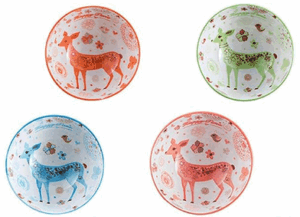
fortunately I bought myself a set of the same bowls at the time (for $8, not for the $30-plus-shipping they are charging now)