After we watched The Sound of Music on New Year’s Eve, I got interested in Julie Andrews and have read a couple of books. The first was Home: A Memoir of My Early Years, written by Julie Andrews.
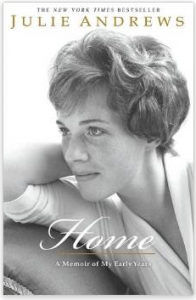
(image from Amazon.com)
I almost didn’t get past the first few pages, which are along the lines of “My great-great grandmother was born in…” It was hard to keep track of who was who (“Let’s see, so now we are talking about your mother’s father’s mother’s sister”), and seemed like the sort of information that would work better as a little picture of the family tree at the beginning, or distributed throughout the rest of the book only as needed for a particular story. But I was glad I persevered past the basic genealogy, because it got better after that.
As the title warns, this is only about her early years. It stops before The Sound of Music and Mary Poppins, and before her divorce and remarriage. It covers more about her childhood and family, and her training, and her successes before the Big Success started happening, and generally how she got started.
I felt like she was trying to be fair, and also trying to be warm and personal and give some revealing details (I hadn’t realized it, but she has a reputation for being private, and hard to get to know). I do think she partially succeeds. But the book overall still had a feeling of “Everyone was just wonderful” plus “This is the material I use for interviews, plus some new personal stuff to balance my reputation for being withholding.”
Next I read Julie Andrews: An Intimate Biography, written by Richard Stirling.
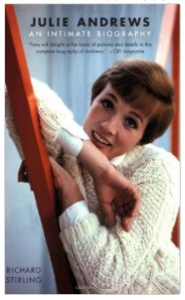
(image from Amazon.com)
My overall impression of this book is that even though it is packed full of numbers and names and quotes from articles, it was written from almost nothing. Julie Andrews does not appear to have cooperated, despite the author saying “Julie Andrews told me” at every single point he possibly could: it seems as if he’s trying to imply she told him for the purposes of the book, but that she didn’t. My guess is that if I bothered to look into it (can’t…quite…reach…Wikipedia…), I’d find that he was a journalist who did an interview or two with her for a magazine, or got a comment from her at a press conference, and used those few occasions to make it seem as if he is her official, chosen confidante/biographer. The rest of it seems written from articles and interviews and official records and things other people said about other things; there is very little about Julie Andrews HERSELF. Lots of “Rehearsals began on such-and-such a date, and here are several pages mentioning every single person involved with the project, and here are quotes about how a bunch of other people felt about the project, and here are a bunch of reviews, and a bunch of back story on people we don’t really care about, because otherwise this is not enough material for a book.” I did a fair amount of skimming.
This book does mention Julie Andrews’s divorce, but seeing the author try to tell the story is what shows how very private Julie Andrews must be: the author tries to write about it, but doesn’t have enough material to go on. There is a lot of fluffing up of the very few details known, and then suddenly we’re past that part and you think, “Wait…did I miss it?” I felt some sympathy for the author: I think he was stuck trying to write an account of a marriage/divorce based on nothing more than what was available from public court records. Lots of “It must have been,” very little “This is how it was.” Like if you imagine one of those celebrity couples saying “It was amicable, we remain the best of friends,” and now someone wants you to write a chapter from that about what the marriage was truly like and what happened to it and who was at fault and how each person felt about it.
This continues in the descriptions of her second marriage (to Blake Edwards), her step-parenting of her second husband’s two children, and her adoption of two children. The author is TRYING to give us the scoop, but he doesn’t know it either. He’s got the publicly-available information, and that’s it. Miss Grace and I were talking about it afterward, and agreed that both of us REALLY ADMIRE celebrities who manage to keep their private lives separate—while simultaneously wishing WE PERSONALLY had access to the details.
I ended the book feeling quite low. If you’d asked me beforehand, “Do you think Julie Andrews has had a nice life and good career?,” I would have said yes. But it felt as if the book highlighted every disappointment, every poor review, every not-quite-a-roaring-success project. And her marriage to Blake Edwards could have been a spectacular marriage in nearly every way, but I ended up with the impression that he was a very difficult person who ruined her life trying to further his own career.
But of course it’s all SPIN. When I looked up one of the projects the book describes as an unmitigated disaster, I see that many people considered it a huge creative success even though it wasn’t a huge financial success. When there were a bunch of negative reviews quoted, I wondered what percentage those were of the total number of reviews: were we getting a representative sampling, or was the author choosing the quotes that further the plot as he’s decided to tell it? When the author uses the verb “confessed” instead of the word “said,” is he accurately representing the situation or is he making us feel something that isn’t true? (This is the problem with all biographies, not just THIS biography.) It also made celebrity/fame very unappealing, but that’s a nice thing to be reminded of from time to time.
All of it was a reminder that there is something that makes some of us want to know more about celebrities—but that we can’t actually have that information. All we can have is what is produced when other people (including the celebrity) see a want and try to fill it.